
SEO Content Strategy: How to Build a Content Plan That Generates Organic Traffic
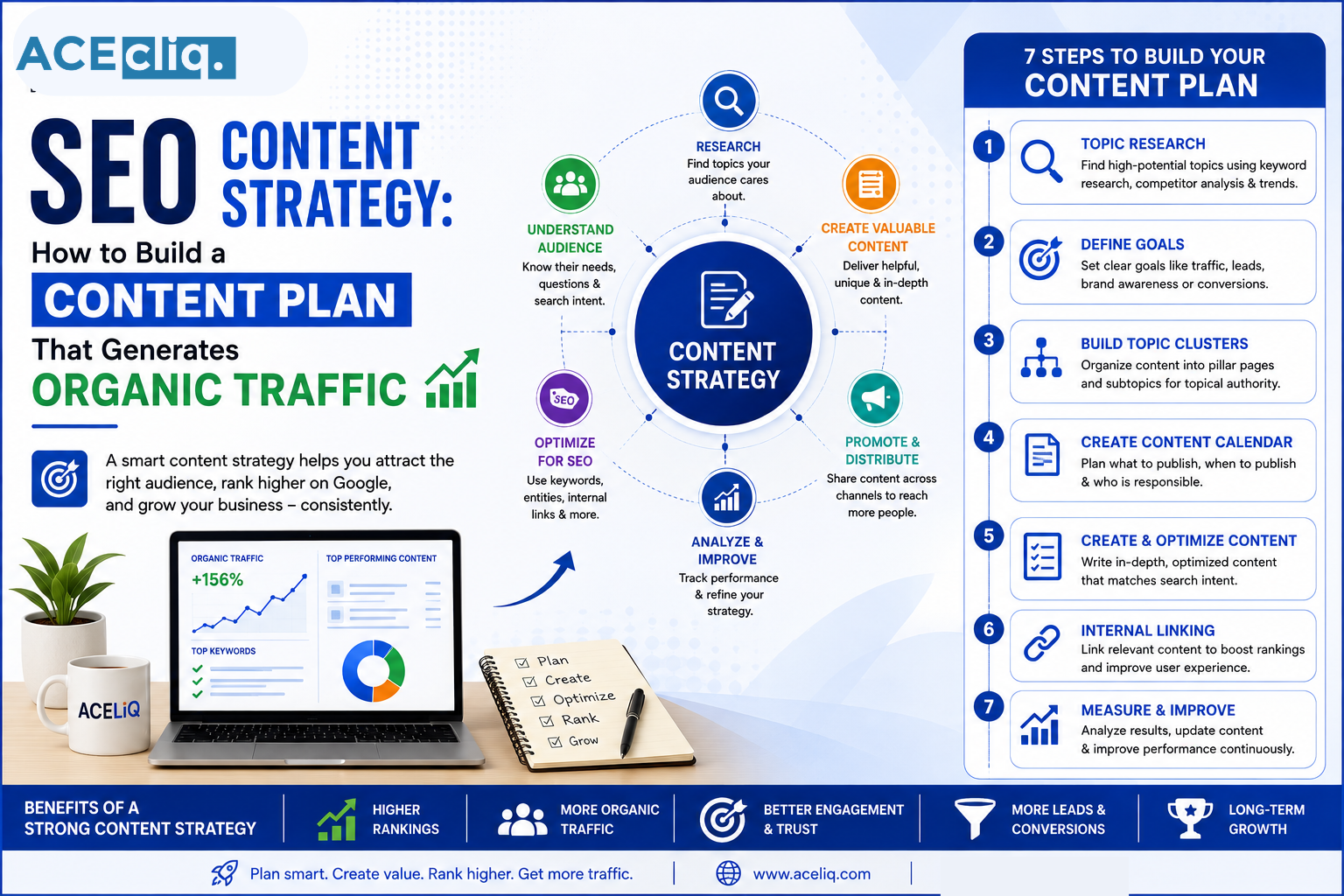
Creating content consistently does not guarantee organic traffic. Many businesses publish blogs every week but still struggle to achieve meaningful Google visibility because their content is created without a clear strategy. A successful content strategy begins with understanding what your audience searches for, why they search for it, and what information they need at each stage of their decision-making process.
An effective SEO Content Strategy brings these elements together. It helps businesses decide what to publish, which keywords and topics to target, how different pages should connect, and how content should be improved over time.
At ACECLiQ, we develop data-driven content strategies that combine keyword research, search intent, topical authority, content optimization, and internal linking to help businesses attract qualified organic traffic and turn visitors into potential customers.
AI Overview
An effective SEO Content Strategy is a structured plan for creating, optimizing, publishing, and improving content to attract relevant organic search traffic. It combines keyword research, search intent, topic clusters, topical authority, content mapping, internal linking, and ongoing performance analysis. Instead of publishing random blog posts, businesses can use an SEO content plan to target different stages of the customer journey and create interconnected resources that answer relevant searches. A well-planned strategy can increase organic visibility, attract qualified visitors, and support long-term lead generation.
What Is an SEO Content Strategy?
An SEO Content Strategy is a structured approach to planning and creating content specifically designed to attract relevant visitors from search engines.
It goes beyond choosing keywords and writing articles.
A complete strategy considers your business objectives, target audience, search behavior, competitors, content gaps, search intent, website structure, and conversion goals.
For example, an SEO agency should not simply publish articles about "SEO." It can build a content ecosystem around technical SEO, local SEO, on-page optimization, SEO audits, keyword research, content marketing, link building, and SEO performance measurement.
Each topic supports the larger subject while creating opportunities to rank for relevant searches.
Why Businesses Need an SEO Content Plan
Publishing content without a plan often creates inconsistent results. A structured SEO Content Plan gives every piece of content a purpose. It helps businesses prioritize subjects that have genuine search demand and align with their products or services. A well-developed plan can help improve organic visibility, build topical authority, attract qualified visitors, support internal linking, and create more opportunities for conversions. It also prevents businesses from repeatedly covering the same subjects while important content gaps remain unanswered.
Define Your SEO and Business Goals
Before researching keywords, determine what the content strategy needs to accomplish.
A business may want to increase organic traffic, generate leads, promote a particular service, increase ecommerce sales, or establish authority within a specific industry.
These objectives influence the type of content you should create.
For example, an informational blog may attract users at the awareness stage, while a detailed service page can target users who are already ready to contact a provider.
Your content strategy should therefore connect search visibility with actual business outcomes.
Understand Your Target Audience
Effective content starts with understanding the people you want to reach. Research their problems, questions, preferences, objections, and buying behavior. Think about what your customers search before they know your brand, what they search while comparing solutions, and what information they need before contacting your business. Customer conversations, sales questions, support requests, search suggestions, competitor content, and existing website analytics can all provide useful insights. The more accurately you understand your audience, the easier it becomes to create relevant content.
Conduct Keyword Research
Keyword Research identifies the phrases and topics your potential customers use when searching online.
However, modern keyword research should not focus exclusively on search volume.
Consider relevance, competition, commercial value, search intent, and the relationship between keywords and broader topics.
For example, a business targeting "digital marketing" may discover related searches around SEO, PPC, social media, content marketing, lead generation, conversion optimization, and marketing analytics.
These related terms can help build a comprehensive Organic Traffic Strategy.
Analyze Search Intent
Keyword research tells you what people search for. Search intent helps you understand why they search.
A query such as "what is SEO" indicates informational intent.
A search such as "best SEO agency for small business" suggests commercial investigation.
A query such as "SEO services" may have strong transactional intent.
Your content format should match that intent.
Trying to rank a promotional service page for a highly informational query or an educational article for a transactional query, can make ranking and conversion more difficult.
Build Topic Clusters
One of the most effective ways to organize an SEO content strategy is through Topic Clusters. A topic cluster consists of a broad pillar topic supported by several detailed articles covering related subtopics.
For example, a website targeting digital marketing could have a central digital marketing resource supported by articles covering SEO, PPC, social media marketing, content marketing, email marketing, analytics, and conversion optimization.
These pages can be connected through relevant internal links. This structure helps users explore related information and creates a logical topical architecture.
Create Pillar and Supporting Content
Pillar content provides comprehensive coverage of a broad subject.
Supporting content focuses on narrower questions and subtopics.
For example, a pillar page about SEO could link to detailed resources explaining technical SEO, keyword research, on-page optimization, local SEO, and SEO audits.
Each supporting article should provide unique value rather than simply repeating information from the pillar page.
Together, these resources create a stronger Content Strategy for SEO and provide multiple opportunities to attract organic search traffic.
Map Keywords to the Right Pages
Keyword Mapping prevents multiple pages from competing for the same search intent. Assign your primary topic or keyword group to the page that best satisfies the searcher's needs.
For example, a commercial keyword should generally be mapped to an appropriate service or product page, while an informational query may be better suited to a blog or guide.
This approach helps create a clear relationship between keywords, pages, topics, and user intent. It can also reduce unnecessary content duplication and keyword cannibalization.
Optimize Content for Search and Users
Once your content topics are planned, each page should be optimized naturally. Use the primary keyword where appropriate, but also include relevant concepts and terminology that help explain the subject. Strong content should have a clear title, logical H2 and H3 headings, concise paragraphs, useful examples, relevant internal links, descriptive image alt text, and a clear next step where appropriate. Most importantly, content should answer the user's question better than simply trying to satisfy a keyword checklist.
Build a Strong Internal Linking Strategy
Internal links connect related content across your website. They help users discover additional information while creating relationships between pages.
For example, an article about keyword research could naturally link to content about search intent, on-page SEO, SEO audits, and content strategy. Your pillar pages should receive relevant links from supporting articles, while supporting pages can link to other closely related resources.
A thoughtful internal linking structure improves navigation and strengthens the overall architecture of your website.
Create an SEO Content Calendar
An SEO Content Calendar turns your strategy into an actionable publishing schedule. Instead of deciding what to write every week, plan content several months in advance. Your calendar can include the target topic, primary keyword, search intent, content format, target audience, supporting keywords, internal links, author, publishing date, and update date.
However, consistency does not mean publishing as much content as possible. Publishing fewer high-quality resources that genuinely address important topics can be more valuable than producing large quantities of repetitive content.
Update and Refresh Existing Content
An SEO content strategy should not end after publication.
Search behavior changes, competitors publish new resources, facts become outdated, and search results evolve. Review important pages regularly to identify outdated statistics, broken links, missing information, and new questions that should be addressed. Refreshing an existing high-potential page can sometimes produce better results than creating another article from scratch. Content maintenance should therefore be an ongoing part of your strategy.
Measure Organic Traffic and Content Performance
You need data to determine whether your content strategy is working. Monitor organic impressions, clicks, rankings, engagement, conversions, and the performance of individual landing pages.
Look beyond total traffic.
A page attracting 1,000 visitors but producing no relevant leads may be less valuable than a page attracting 200 highly qualified visitors. Use performance data to identify which topics deserve further investment and which pages need improvement.
Common SEO Content Strategy Mistakes
One of the biggest mistakes is creating content solely because a keyword has high search volume.
High search volume does not automatically mean high business value.
Other common problems include publishing without understanding search intent, creating multiple pages targeting the same topic, ignoring internal linking, relying excessively on AI-generated content, and failing to update existing resources.
Another mistake is measuring success exclusively through rankings.
A successful strategy should connect rankings and traffic with engagement, leads, conversions, and business growth.
A Simple SEO Content Strategy Framework
Businesses can simplify their planning process into five stages.
Research: Understand your audience, competitors, keywords, questions, and search intent.
Plan: Organize topics into clusters and map them to appropriate pages.
Create: Produce useful, original, expert-driven content that satisfies the intended search.
Connect: Use internal links to create meaningful relationships between related pages.
Improve: Analyze performance, update content, and fill emerging content gaps.
This creates a repeatable system that can scale as your website grows.
Final Conclusion
A successful SEO Content Strategy is not about publishing the maximum number of blog posts. It is about creating the right content for the right audience at the right stage of their search journey.
By combining keyword research, search intent, topic clusters, pillar content, supporting articles, internal linking, and continuous optimization, businesses can create a website that attracts relevant organic traffic and builds long-term topical authority. The most effective content strategies also connect SEO with business objectives. Traffic is valuable, but qualified traffic that generates inquiries, sales, and loyal customers is far more valuable.
At ACECLiQ, we help businesses develop strategic SEO content plans that identify high-value topics, map search intent, build topical authority, optimize existing content, and create sustainable organic growth.