
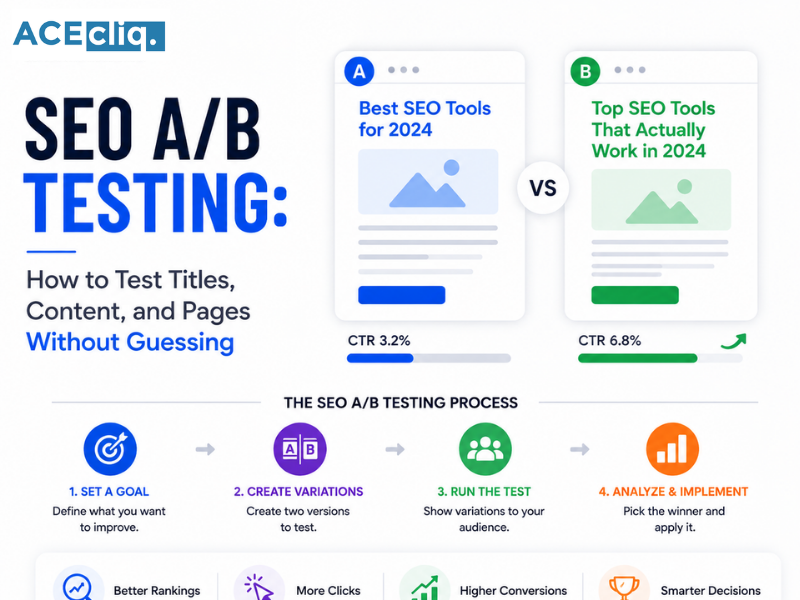
SEO A/B Testing: How to Test Titles, Content, and Pages Without Guessing
SEO involves making hundreds of decisions about titles, content, internal links, page structure, and user experience. But not every optimization produces the same result.
Instead of assuming that a particular change will improve performance, businesses can use SEO A/B Testing to evaluate changes using real data.
SEO testing can help answer practical questions such as whether a new title generates more clicks, whether a content update improves organic visibility, or whether a different page structure improves performance.
The goal is simple: replace assumptions with measurable evidence.
At ACECLiQ, we use data-driven SEO analysis to identify opportunities, test strategic changes, and measure performance rather than relying solely on assumptions or generic SEO recommendations.
AI Overview
SEO A/B Testing is a data-driven approach to evaluating changes to webpages and measuring their impact on organic search performance. Businesses can test elements such as title tags, page content, templates, internal links, and other SEO changes to understand what improves visibility, clicks, or conversions. Because organic search is influenced by many variables, tests should change one meaningful element at a time, use appropriate control groups where possible, and run long enough to collect useful data. SEO testing helps replace assumptions with evidence and supports more informed optimization decisions.
What Is SEO A/B Testing?
SEO A/B Testing involves comparing the performance of webpages before and after a controlled SEO change, or comparing test and control groups where the experiment allows it.
Traditional A/B testing is common in conversion optimization, where visitors may see different versions of a page.
SEO testing can be more complex because search engines continuously recrawl and reevaluate pages, while rankings are influenced by competitors, algorithms, seasonality, and other external factors.
For this reason, SEO experiments need careful planning and interpretation.
Why SEO Testing Matters
SEO recommendations often sound convincing, but what works for one website may not work exactly the same way for another.
Your audience, industry, competitors, website architecture, and existing authority can all influence results.
Testing allows businesses to discover what works specifically for their website.
For example, changing a title may increase organic CTR without significantly changing rankings. Improving content may increase impressions and rankings but have little effect on conversions.
These insights can guide future optimization decisions.
What Can You Test?
There are several areas where SEO experimentation can provide useful insights.
Title tags can be tested to understand their effect on organic CTR.
Content changes can be evaluated to determine whether improved relevance or depth affects organic visibility.
Internal linking can be tested to understand whether stronger connections between pages improve their performance.
Businesses can also experiment with page templates, headings, category structures, and other scalable SEO elements when the website and testing setup allow reliable measurement.
How to Choose an SEO Test
Start with a clear hypothesis.
Instead of saying, "We should change these titles," define what you expect to happen.
For example:
"Changing the titles on these pages to better match search intent will increase organic CTR."
This gives you something measurable to evaluate.
Choose pages with sufficient search impressions and a meaningful business purpose. Testing a page with almost no organic visibility may produce too little data to draw useful conclusions.
Test Title Tags and Organic CTR
Title tags are one of the most practical areas for SEO testing.
If a page receives substantial impressions but relatively few clicks, the title may present an optimization opportunity.
You can test whether a clearer, more specific, or more compelling title improves Organic CTR.
For example, a generic title could be replaced with one that communicates the page's specific value more clearly.
However, titles should accurately represent the content. Clickbait may increase clicks temporarily but create a poor user experience if the page does not deliver what the title promises.
Test Content and Page Structure
Content experiments can involve improving outdated information, reorganizing sections, clarifying explanations, or addressing missing search-intent questions.
For example, if competing pages provide clearer answers to important questions, you might restructure your content to address those questions earlier.
Measure changes in impressions, clicks, rankings, engagement, and conversions where appropriate.
Avoid changing the entire page at once if your goal is to understand the effect of a specific modification.
The more controlled the experiment, the easier it is to interpret the result.
Test Internal Linking
Internal links can also be evaluated as part of an SEO experiment.
Suppose an important page receives limited internal links from relevant content.
You could add contextual links from several high-value pages and monitor whether its organic visibility changes.
The anchor text should remain natural and descriptive.
Internal linking tests can be particularly useful for larger websites with established content ecosystems.
Use Control and Test Groups
When possible, divide similar pages into a test group and a control group.
The test group receives the SEO change, while the control group remains unchanged.
For example, an ecommerce website could apply a new category-page template to a selected group of similar categories while keeping another comparable group unchanged.
This can make it easier to identify whether performance changes are associated with the experiment rather than broader market or algorithm changes.
The groups should be as comparable as practical.
Don't Change Too Many Variables
If you change the title, content, URL, internal links, and page design simultaneously, it becomes difficult to determine what caused the result.
Where practical, isolate the variable you want to test.
If you are testing titles, keep the major content and technical structure consistent.
If you are testing content improvements, avoid making unrelated changes at exactly the same time.
Controlled experiments produce more useful insights.
Give SEO Tests Enough Time
SEO changes may not produce immediate results.
Search engines need time to crawl, process, and reevaluate updated pages.
The appropriate testing period depends on website size, search demand, crawl frequency, and the type of change being tested.
Avoid declaring a winner based on a few days of data.
Look for sustained patterns rather than short-term fluctuations.
Measure SEO Test Results
The metrics you track should match your original hypothesis.
For a title experiment, CTR, impressions, clicks, and average position may be particularly relevant.
For a content experiment, you may also examine ranking distribution, organic traffic, engagement, and conversions.
For commercial pages, leads or revenue can be more meaningful than traffic alone.
The best Data-Driven SEO decisions connect search performance with actual business outcomes.
Use Google Search Console for Insights
Google Search Console can provide valuable data for SEO experiments.
The Performance report allows you to compare clicks, impressions, CTR, and average position across different periods and search queries.
You can also examine individual pages to understand how their organic visibility changes.
Search Console should not be treated as a perfect experimental environment, but it can provide important evidence when combined with carefully designed tests and other analytics data.
Common SEO Testing Mistakes
One common SEO mistake is testing changes on pages that receive almost no impressions.
Another is changing too many variables simultaneously.
Businesses may also stop experiments too early or interpret normal ranking fluctuations as proof that a change worked.
Seasonality, competitor activity, algorithm updates, and changes in search behavior can influence results.
This is why SEO test results should be interpreted within the broader search environment.
Build a Continuous SEO Testing Process
SEO testing works best as an ongoing process rather than a one-time activity.
Maintain a record of experiments, including the hypothesis, pages tested, changes made, start date, metrics, and results.
Over time, these experiments create a valuable internal knowledge base.
Your team can learn which types of changes consistently improve performance and which assumptions do not hold true for your website.
This makes future SEO Optimization more strategic.
Final Conclusion
SEO A/B Testing helps businesses make optimization decisions based on evidence rather than assumptions.
By carefully testing titles, content, internal links, page structures, and other SEO elements, businesses can better understand what actually improves their organic performance.
The key is to start with a clear hypothesis, control variables where possible, use suitable test and control groups, allow enough time for results to develop, and measure outcomes against meaningful SEO and business metrics.
SEO is rarely a one-time optimization project. Search behavior, competitors, content, and websites continue to change.
A continuous testing mindset allows businesses to learn from their own data and make smarter decisions over time.
At ACECLiQ, we help businesses combine SEO analysis, experimentation, content optimization, and performance measurement to create data-driven strategies that improve search visibility and support sustainable organic growth.