
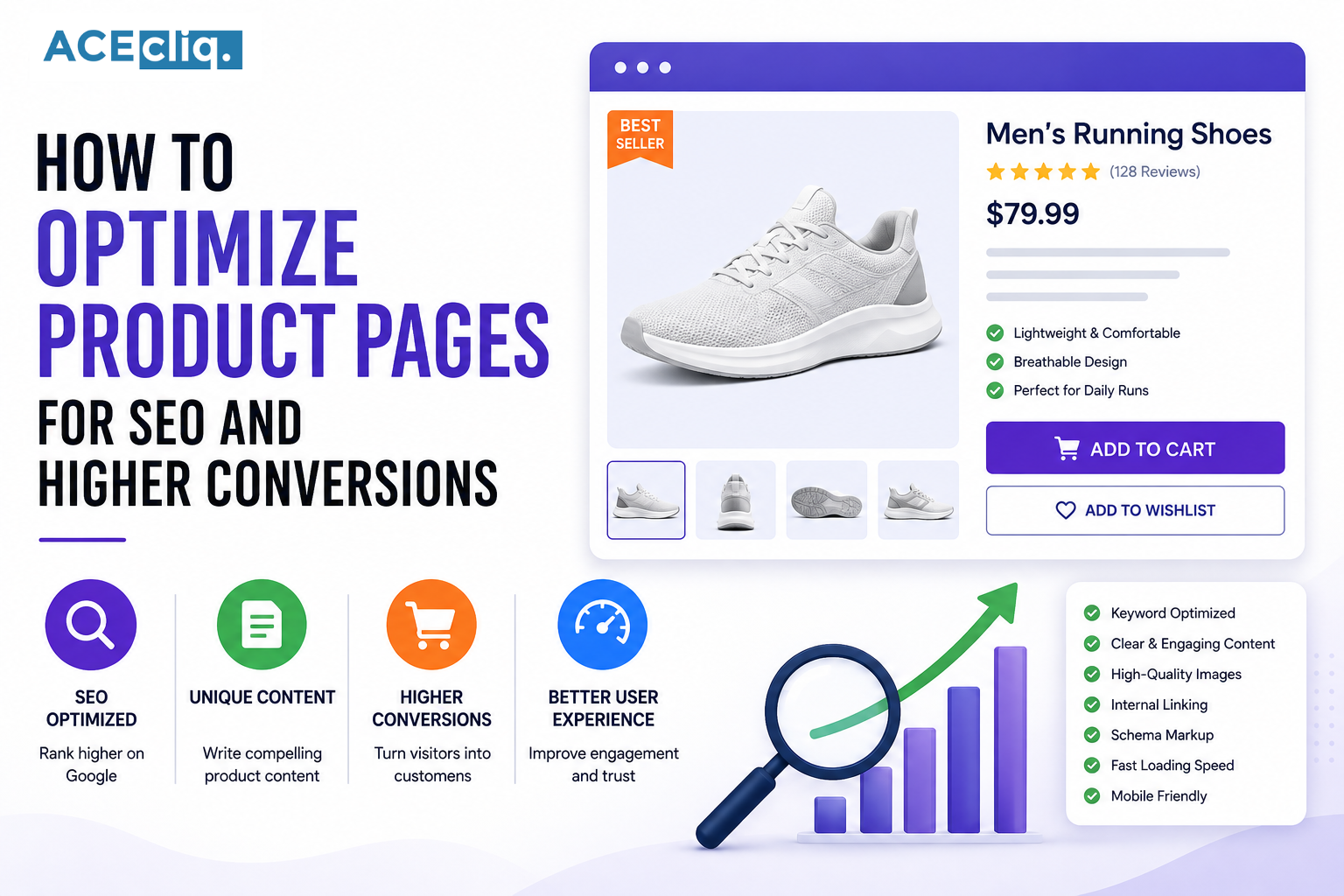
How to Optimize Product Pages for SEO and Higher Conversions
Getting shoppers to your online store is only the first step. If your product pages are poorly optimized, visitors may leave without purchasing and search engines may struggle to understand what your products offer.
This makes Product Page SEO an important part of ecommerce growth.
A strong product page needs to satisfy two audiences at the same time. Search engines need clear information about the product, while shoppers need accurate details, high-quality images, reviews, pricing, and enough confidence to make a purchase.
The best approach is therefore not to optimize product pages for rankings alone. Instead, combine Ecommerce SEO with user experience and conversion optimization.
At ACECLiQ, we help ecommerce businesses optimize product pages to improve organic visibility, attract qualified shoppers, and create a smoother path from Google search to purchase.
AI Overview
Product Page SEO involves optimizing individual ecommerce product pages so search engines can understand the product while shoppers have the information they need to make a purchase. Effective optimization includes relevant keyword targeting, unique product descriptions, clear titles, optimized images, product structured data, reviews, internal links, fast page performance, and strong calls to action. The best product pages balance search visibility with user experience, helping attract qualified organic traffic while reducing purchase uncertainty and improving conversions.
What Is Product Page SEO?
Product Page SEO is the process of optimizing individual product pages so they can appear for relevant searches and provide a useful shopping experience.
A product page should clearly communicate what the product is, who it is for, its important features, available options, price, and purchasing information.
SEO elements such as titles, descriptions, URLs, structured data, images, and internal links help search engines understand the page.
At the same time, persuasive but accurate content, reviews, trust signals, and clear CTAs can help turn visitors into customers.
Match Product Pages With Search Intent
Before optimizing a product page, understand what shoppers are searching for.
Someone searching for a specific product name usually has much stronger purchase intent than someone searching for a broad informational topic.
For example, a search for "Nike running shoes size 9" indicates a different level of intent from "best running shoes for beginners."
Product pages should focus on searches that are genuinely relevant to the specific product.
The content should then help the visitor make a confident purchasing decision.
Optimize Product Titles and URLs
The product title is one of the first elements users and search engines encounter.
Create descriptive titles that clearly identify the product, brand, model, key variation, or important attribute where appropriate.
Avoid unnecessary keyword repetition.
Your URL should also be short, descriptive, and stable.
For example:
/running-shoes/mens-trail-shoes/
is generally easier to understand than a URL filled with random parameters.
Avoid changing product URLs unnecessarily because frequent URL changes can create redirects and indexing complications.
Write Unique Product Descriptions
One of the most common ecommerce SEO problems is duplicate product content.
Many stores copy manufacturer descriptions and publish the same text used across multiple websites.
Instead, create unique product descriptions that explain the product from your customer's perspective.
Highlight important features, use cases, specifications, benefits, compatibility, materials, sizing, or other information relevant to the purchase decision.
Don't write content simply to increase word count.
The purpose is to answer the questions a shopper may have before purchasing.
Use Relevant Product Keywords
Keyword Research can help identify how customers search for your products.
Focus on product names, brands, models, specifications, attributes, and relevant commercial phrases.
Use these terms naturally in the product title, description, headings, image alt text, and other appropriate areas.
Avoid keyword stuffing.
Search engines are increasingly capable of understanding context and relationships between terms, so natural and useful language is more valuable than repeatedly inserting the same phrase.
Optimize Product Images
Product images are critical for ecommerce because shoppers cannot physically examine the product.
Use high-quality images that clearly show the product from useful angles.
At the same time, optimize image file sizes so they do not unnecessarily slow down the page.
Use descriptive filenames and appropriate Image SEO practices, including useful alt text where relevant.
Images should help both shoppers and search engines understand the product without compromising page performance.
Add Product Reviews and Trust Signals
Reviews can help shoppers evaluate products and reduce uncertainty.
Display genuine customer reviews clearly and make it easy for visitors to understand what other buyers experienced.
Other trust signals can include ratings, return information, shipping details, warranties, secure payment information, and clear contact options.
The exact trust elements depend on your business model, but the underlying principle is simple: answer the questions that might prevent a customer from completing the purchase.
Implement Product Structured Data
Product Structured Data can help search engines understand information about products, such as price, availability, ratings, and other relevant attributes when eligible.
Implement structured data accurately and keep it consistent with the visible information on the page.
Do not add structured data for information that users cannot actually find on the product page.
Structured data can support search visibility, but it does not guarantee enhanced search results.
Strengthen Internal Linking
Internal links help search engines and shoppers discover your products.
Link products from relevant category pages, subcategories, buying guides, comparison articles, and related product sections.
For example, an article about choosing running shoes can naturally link to relevant running shoe products.
Likewise, product pages can link to appropriate categories or related products.
This creates a stronger Ecommerce Site Architecture and improves product discoverability.
Improve Product Page User Experience
A product page should make purchasing as easy as possible.
Important information should be easy to find without forcing shoppers to search through large blocks of text.
Make pricing, availability, variations, shipping, returns, and purchasing options clear.
Your primary CTA should also be obvious.
For example, depending on the business, this could be "Add to Cart," "Buy Now," "Request a Quote," or another relevant action.
Good UX supports both SEO and conversions.
Optimize for Mobile and Page Speed
Many ecommerce shoppers use mobile devices, making mobile usability essential.
Product pages should load quickly, display images properly, and make buttons and product options easy to use on smaller screens.
Avoid excessive scripts, unnecessarily large images, and intrusive elements that interfere with shopping.
Improving Ecommerce Page Speed can create a better experience while supporting the overall technical quality of your website.
Handle Out-of-Stock Products Carefully
Products may become unavailable temporarily or permanently.
Don't automatically delete every out-of-stock page.
If the product is temporarily unavailable and expected to return, keeping the page accessible may allow you to preserve its search visibility and provide useful information to customers.
If a product has been permanently discontinued, determine whether there is a highly relevant replacement or category page.
Where appropriate, redirects can help users reach the closest useful alternative.
Optimize Product Variations
Products often have different sizes, colors, materials, or models.
Decide carefully whether variations should use separate URLs or exist within a single product page.
Creating hundreds of nearly identical URLs can make ecommerce SEO unnecessarily complicated.
Your URL structure should reflect meaningful differences rather than every minor variation.
Measure SEO and Conversion Performance
Product page success should not be measured through rankings alone.
Monitor organic impressions, clicks, keyword visibility, product-page traffic, conversion rate, revenue, and other relevant ecommerce metrics.
A product page that receives substantial organic traffic but generates few sales may have a conversion problem.
Review factors such as product presentation, pricing, reviews, shipping information, trust signals, and page experience.
The objective is to attract qualified organic traffic that contributes to revenue.
Common Product Page SEO Mistakes
Common mistakes include copying manufacturer descriptions, using poor-quality images, ignoring structured data, creating overly complex URLs, neglecting internal links, and optimizing only for keywords.
Other problems include slow product pages, missing product information, unclear CTAs, weak mobile experiences, and allowing discontinued products to create unnecessary dead ends.
The strongest Ecommerce SEO Strategy treats product pages as both search landing pages and sales pages.
Final Conclusion
Product Page SEO is about more than helping individual products rank on Google. A successful product page needs to attract relevant searchers, communicate product value, answer purchase-related questions, establish trust, and make the buying process simple.
Focus on search intent, unique product content, relevant keywords, optimized images, structured data, reviews, internal linking, mobile performance, and conversion-focused UX.
When SEO and ecommerce conversion optimization work together, product pages can become powerful sources of both organic traffic and revenue.
At ACECLiQ, we help ecommerce businesses improve product page optimization, technical SEO, internal linking, content quality, and conversion experiences to build stronger organic visibility and turn more searchers into customers.