
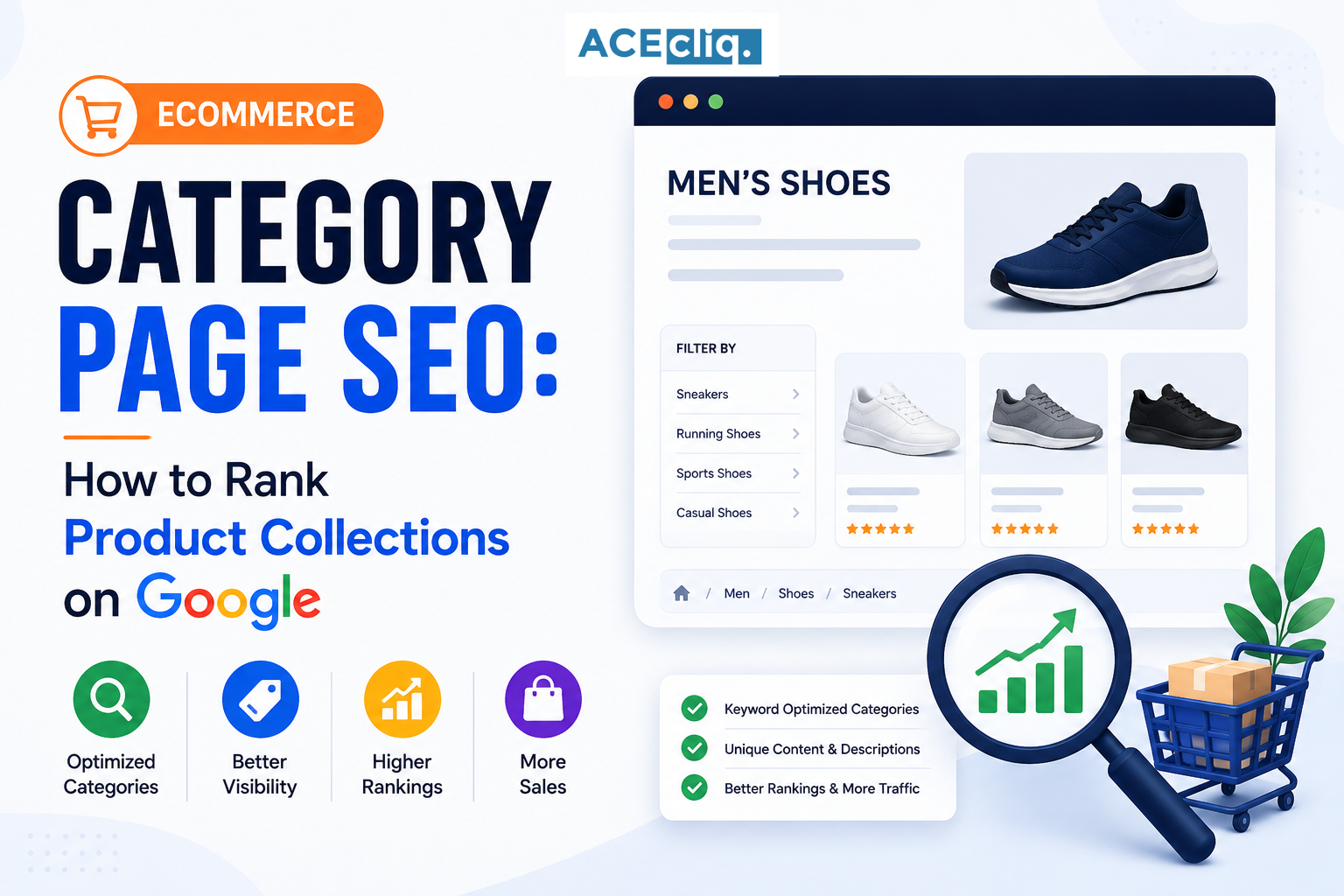
E-commerce Category Page SEO: How to Rank Product Collections on Google
E-commerce websites often focus most of their SEO efforts on individual product pages. However, category and collection pages can be equally important because they target broader commercial searches and help shoppers discover multiple products.
A well-optimized category page can rank for searches where users are actively looking for a particular type of product but have not yet decided which specific item to purchase.
This makes Ecommerce Category Page SEO an important part of a successful online store strategy.
The goal is not simply to add keywords to category pages. Businesses need to create useful category pages that clearly communicate what products are available, satisfy search intent, provide easy navigation, and help both users and search engines understand the site's structure.
At ACECLiQ, we help ecommerce businesses optimize category pages, product architecture, internal links, content, and technical SEO to improve organic visibility and attract qualified shoppers.
AI Overview
eCommerce Category Page SEO focuses on optimizing product collection and category pages so search engines can understand what products are offered and match them with relevant searches. Effective optimization includes targeting appropriate category-level keywords, matching search intent, creating useful category content, maintaining a logical ecommerce site architecture, strengthening internal links, and managing filters and faceted navigation carefully. Well-optimized category pages can attract high-intent shoppers, improve organic visibility, and create a stronger path from Google search to product discovery.
What Is Ecommerce Category Page SEO?
Ecommerce Category Page SEO is the process of optimizing product category or collection pages to improve their visibility in organic search results.
For example, an online clothing store may have categories such as men's shoes, women's dresses, running shoes, formal shirts, or winter jackets.
These pages can target broader commercial searches while individual product pages target specific product names or models.
A strong category page acts as a bridge between search results and individual products.
Why Category Pages Matter for Ecommerce SEO
Category pages often sit near the top of an ecommerce website's hierarchy.
They help users move from a broad product type toward individual products.
From an SEO perspective, they can also accumulate internal links from navigation, related categories, blog content, and product pages.
Because category pages target broader terms, they may attract users earlier in the purchasing process.
For example, someone searching for "running shoes for men" may not know which specific brand or model they want. A well-optimized category page can help them compare relevant products.
Understand Category-Level Search Intent
Before optimizing a category page, understand what users expect to find.
A search for a broad product category usually has commercial or transactional intent.
Users generally want to browse products, compare options, understand available features, and potentially make a purchase.
Your page should therefore provide immediate access to relevant products rather than turning into a long informational article.
Content should support the shopping experience rather than interfere with it.
Find the Right E-commerce Keywords
Keyword Research helps identify the terms shoppers use to discover product categories.
Focus on commercially relevant keywords rather than choosing terms only because they have high search volume.
For example, an online furniture store might target terms such as "office chairs," "ergonomic office chairs," or "mesh office chairs" depending on its category structure and inventory.
Consider search volume, competition, product availability, commercial intent, and relevance before assigning keywords to category pages.
Avoid creating a separate category for every minor keyword variation.
Create Useful Category Page Content
Category pages should contain enough information to help search engines and shoppers understand the collection.
A short introduction can explain what the category includes, who the products are for, and what shoppers should consider when choosing between options.
For larger categories, additional useful information can be placed below the product listings.
However, avoid adding hundreds of words simply to make a page appear "SEO optimized."
Category Page Optimization should prioritize relevance and usefulness.
Optimize Category Page Titles and Headings
Each category page should have a clear and descriptive title.
The primary category topic should be reflected naturally in the title, H1, URL, and relevant page content.
For example, an ecommerce website selling footwear could have:
H1: Men's Running Shoes
The title and supporting content can then clarify the types of products available.
Avoid stuffing multiple keyword variations into headings.
A clear structure helps both users and search engines understand the purpose of the page.
Build Strong Internal Links
Internal Linking is particularly important for ecommerce websites because they often contain thousands of URLs.
Your main categories should be accessible through the site's navigation.
Relevant subcategories can link to broader categories, while product pages can connect back to their appropriate categories.
Blog content can also link naturally to relevant product collections.
For example, an article about choosing running shoes could link to the site's running shoe category.
This creates useful relationships between informational content, categories, and products.
Optimize Product Listings

The products displayed on a category page should closely match the category's search intent.
Use clear product names, high-quality images, descriptive information, pricing where appropriate, and easy navigation.
Make sure important products are discoverable through normal HTML links rather than relying entirely on scripts or interactions that search engines may not process as expected.
Pagination should also be implemented carefully so users can efficiently explore larger collections.
Handle Filters and Faceted Navigation Carefully
Ecommerce websites commonly use filters for size, color, brand, price, material, and other attributes.
These features are excellent for shoppers but can create thousands of URL combinations.
This is known as Faceted Navigation.
Not every filtered URL needs to be indexed.
Businesses should determine which combinations represent meaningful search demand and which should remain primarily navigation options.
Poorly managed filters can create duplicate or low-value URLs and make crawling more complicated.
Create a Search-Friendly Ecommerce Architecture
A clear ecommerce architecture might look like:
Homepage → Category → Subcategory → Product
For example:
Home → Shoes → Running Shoes → Men's Running Shoes → Product
This structure creates clear relationships between product collections and individual products.
Keep important categories reasonably accessible and avoid unnecessarily deep structures.
A logical Ecommerce Site Architecture also makes it easier to manage internal links, navigation, breadcrumbs, and future product additions.
Optimize Category URLs
URLs should be short, descriptive, and stable.
A URL such as:
/mens-running-shoes/
is clearer than a URL containing random parameters or unnecessary words.
Avoid changing category URLs frequently.
If a URL must change, implement appropriate redirects and update internal links to the new destination.
Stable URLs make ecommerce websites easier to manage as they grow.
Use Breadcrumb Navigation

Breadcrumbs help shoppers understand where they are within the ecommerce hierarchy.
For example:
Home → Shoes → Running Shoes → Men's Running Shoes
This improves navigation and reinforces the relationship between categories and products.
Breadcrumbs can be especially useful for large ecommerce websites with multiple category levels.
Improve Category Page User Experience
SEO and ecommerce UX should work together.
A category page should load efficiently, work well on mobile devices, and allow shoppers to find relevant products quickly.
Avoid overwhelming users with unnecessary pop-ups, intrusive elements, or difficult navigation.
High-quality product images, useful filters, clear product information, and intuitive sorting can make the browsing experience more effective.
A better user experience can also support stronger engagement and conversions.
Don't Over-Optimize Category Pages
Keyword Stuffing is not an effective ecommerce strategy.
You do not need to repeat the category keyword throughout every paragraph.
Instead, use natural terminology that describes the products, attributes, use cases, and customer needs.
For example, a running shoe category can naturally discuss cushioning, terrain, fit, running style, and shoe type where relevant.
This creates useful contextual content without making the page sound artificial.
Common E-commerce Category SEO Mistakes
Several mistakes can limit category page performance.
Common problems include creating thin category pages, using duplicate descriptions, targeting the same keyword with multiple categories, indexing every filter combination, and hiding important products behind difficult navigation.
Other issues include slow page performance, unclear URLs, weak internal links, and frequently changing category structures.
A successful Ecommerce SEO strategy should address these issues together rather than treating content optimization as a standalone task.
How to Measure Category Page Performance
Track category pages using organic impressions, clicks, rankings, CTR, organic conversions, and revenue where available.
Look for categories that receive strong impressions but few clicks. These may benefit from improved search snippets.
Also identify pages receiving traffic but generating few sales. These may have issues with product relevance, user experience, pricing, trust, or conversion optimization.
SEO success should ultimately be connected to business performance.
Final Conclusion
Ecommerce Category Page SEO helps online stores build visibility for broader product searches while guiding shoppers toward relevant products.
The strongest strategy combines keyword research, search intent, useful category content, clear website architecture, internal linking, optimized product listings, and careful management of filters and URLs.
Don't treat category pages as simple product containers. They are important landing pages that can attract high-intent searchers and introduce them to your product range.
At ACECLiQ, we help ecommerce businesses build search-friendly category structures, optimize collection pages, strengthen internal linking, and improve technical SEO to attract qualified organic traffic and support sustainable online sales.