
E-commerce SEO Guide: How to Rank Your Online Store in 2026 | ACECLiQ
The ecommerce industry continues to grow rapidly, making online competition more intense than ever before. Every day, thousands of new online stores launch, competing for the same customers on search engines. Simply creating an ecommerce website is no longer enough. To attract consistent traffic and generate sales, businesses need a strong SEO strategy that helps their products appear when potential customers search online.
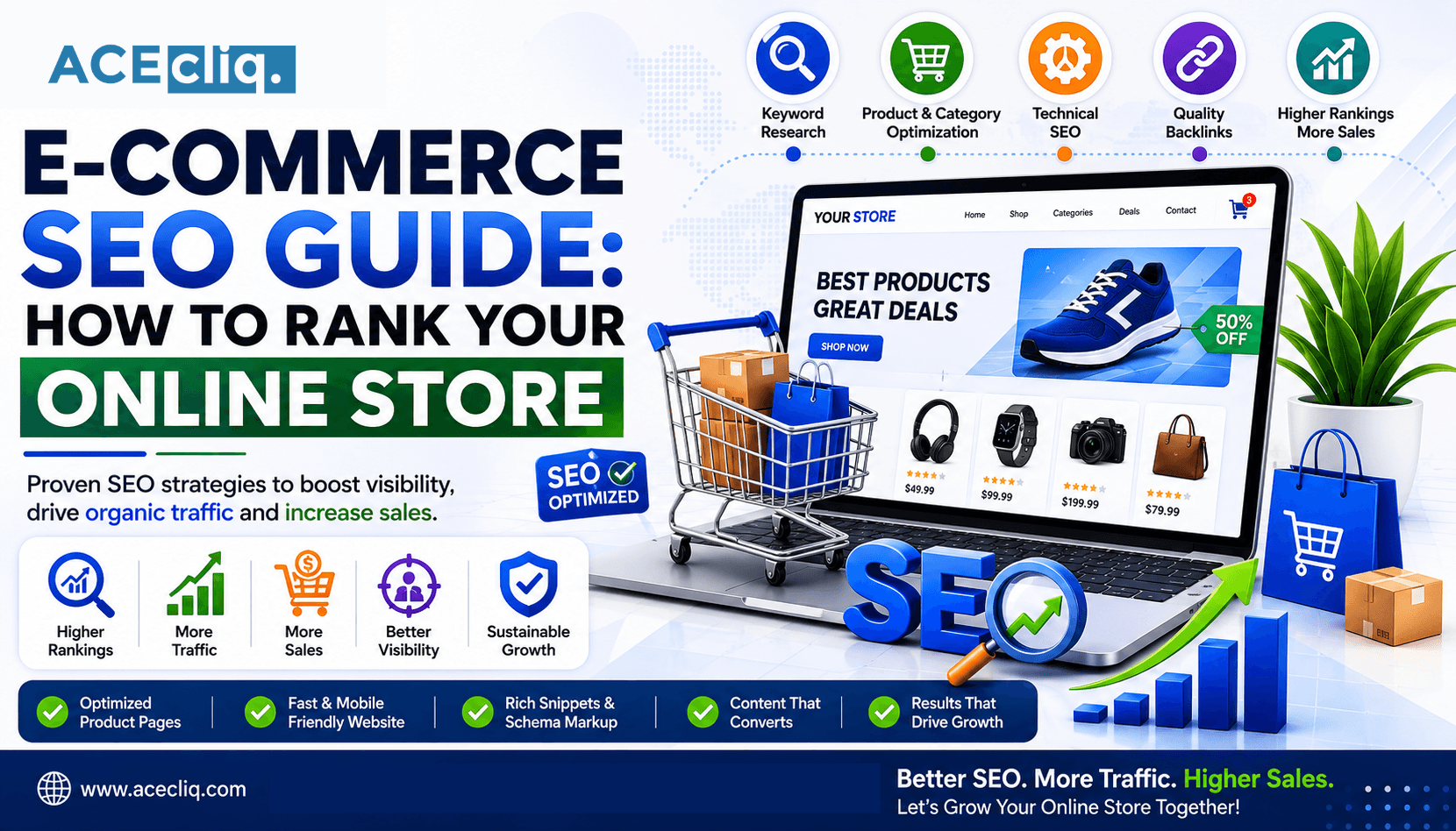
This E-commerce SEO Guide: How to Rank Your Online Store explains the essential techniques businesses should implement to improve visibility, increase organic traffic, and drive more sales. Modern Ecommerce SEO is no longer just about adding keywords to product pages—it requires a combination of technical optimization, high-quality content, user experience improvements, and authority building.
At ACECLiQ, we help ecommerce businesses implement data-driven SEO for online stores that generate sustainable growth and long-term revenue.
AI Overview
Ranking an online store requires more than simply adding products and waiting for customers to find them. A successful E-commerce SEO Guide: How to Rank Your Online Store focuses on optimizing product pages, improving website speed, enhancing user experience, implementing technical SEO, and creating valuable content that attracts potential buyers. With increasing competition in online retail, businesses must adopt modern Ecommerce SEO strategies to improve search rankings, generate qualified traffic, and increase sales. This guide explains the essential SEO techniques every online store should implement to achieve sustainable organic growth in 2026.
What is Ecommerce SEO?
Ecommerce SEO is the process of optimizing an online store so that product pages, category pages, and informational content rank higher on search engines like Google. Unlike paid advertising, SEO focuses on earning organic traffic by improving the relevance, quality, and technical performance of your website.
An effective ecommerce SEO strategy helps businesses attract visitors who are actively searching for products they intend to purchase. These users typically have higher buying intent, making organic search one of the most profitable traffic sources for ecommerce businesses.
Why SEO Matters for Online Stores
Many online businesses rely heavily on paid advertising. While PPC can generate immediate traffic, it stops delivering results once the advertising budget ends.
A strong Ecommerce SEO strategy creates long-term visibility that continues generating traffic and sales without paying for every click.
Businesses that invest in SEO benefit from:
- Higher organic visibility
- Lower customer acquisition costs
- Better brand credibility
- Increased product discoverability
- Sustainable long-term growth
SEO transforms your website into a long-term business asset rather than a recurring advertising expense.
Start with Smart Keyword Research
Every successful ecommerce campaign begins with proper keyword research.
Rather than targeting only broad keywords, businesses should identify search terms that reflect buying intent. Customers searching for specific product names, brands, comparisons, or pricing are often much closer to making a purchase.
A successful Ecommerce Keyword Research strategy includes commercial keywords, long-tail keywords, product-specific searches, and informational topics that support customer decision-making.
By understanding how customers search, businesses can create pages that match user intent and improve search visibility.
Optimize Every Product Page
Product pages are among the most valuable assets of an ecommerce website.
Each page should provide complete, original, and informative content that helps customers make purchasing decisions. Avoid using manufacturer descriptions because duplicate content reduces SEO performance.
Effective Product On- Page SEO includes optimized titles, compelling meta descriptions, descriptive URLs, unique product descriptions, high-quality images, and structured data.
Product pages should also answer common customer questions and highlight important product benefits.
Build Strong Category Pages
Category pages often rank for highly competitive keywords because they target broader search intent.
Instead of listing products only, category pages should include useful introductory content that explains the product category, buying considerations, and relevant information for shoppers.
Optimized category pages improve both user experience and search engine understanding while strengthening overall Online Store SEO.
Improve Technical SEO
Technical optimization forms the foundation of successful ecommerce SEO.
Search engines must be able to crawl, index, and understand every important page on your website.
A strong Technical SEO for Ecommerce strategy includes fixing crawl errors, improving XML sitemaps, optimizing robots.txt files, implementing canonical tags, and ensuring clean URL structures.
Large ecommerce websites often face indexing challenges due to duplicate pages, product variations, and filter parameters. Regular technical audits help identify and resolve these issues before they impact rankings.
Increase Website Speed
Website speed influences rankings, user experience, and conversions.
Online shoppers expect websites to load quickly. Even small delays can reduce sales and increase bounce rates.
Businesses should optimize images, minimize unnecessary scripts, implement browser caching, and use reliable hosting to improve loading times.
Faster websites provide better shopping experiences while supporting stronger On Page SEO for Online Stores.
Create an Effective Internal Linking Strategy
Internal linking helps search engines discover important pages while guiding customers through the buying journey.
Product pages should naturally connect to related products, buying guides, category pages, and blog articles.
Strong internal links improve crawlability, distribute authority across the website, and encourage visitors to explore more products.
This strategy supports both SEO performance and customer engagement.
Publish Valuable Content
Many ecommerce websites focus only on product listings.
However, informative content helps attract customers before they are ready to buy.
A successful Ecommerce Content Marketing strategy includes buying guides, comparison articles, tutorials, industry insights, FAQs, and educational blogs.
Content builds trust while targeting informational keywords that competitors often ignore.
This approach expands organic visibility beyond product pages alone.
Encourage Customer Reviews
Product reviews provide valuable user-generated content that improves both SEO and customer trust.
Fresh reviews continuously add relevant content to product pages while helping potential buyers make informed decisions.
Businesses should encourage verified customers to leave honest reviews and respond professionally to customer feedback.
Review content often includes natural keywords that strengthen overall relevance.
Build High-Quality Backlinks
Backlinks remain one of Google's strongest ranking signals.
Businesses should focus on earning authoritative links through:
- Guest blogging
- Digital PR
- Industry partnerships
- Resource pages
- High-value content
A strategic Ecommerce Link Building campaign increases domain authority and improves search rankings over time.
Quality always matters more than quantity when building backlinks.
Monitor SEO Performance
SEO is an ongoing process rather than a one-time project.
Businesses should regularly monitor:
- Organic traffic
- Product rankings
- Conversion rates
- Click-through rates
- Revenue from organic search
- Technical health
Continuous analysis helps identify opportunities for improvement while ensuring SEO efforts align with business objectives.
Data-driven optimization is essential for maintaining long-term growth.
Common Ecommerce SEO Mistakes
Many online stores struggle because they repeat the same optimization mistakes.
Common issues include duplicate product descriptions, poor site structure, slow page speed, weak internal linking, missing schema markup, and ignoring technical SEO.
Businesses that regularly audit their websites and update their optimization strategies are far more likely to maintain strong search visibility.
Avoiding these mistakes creates a stronger foundation for sustainable ecommerce success.
Final Conclusion
This E-commerce SEO Guide: How to Rank Your Online Store demonstrates that successful ecommerce SEO requires much more than optimizing a few product pages.
Businesses that invest in Ecommerce SEO, improve technical performance, create valuable content, optimize product pages, and build authority consistently outperform competitors over time.
Organic search remains one of the most profitable acquisition channels for ecommerce businesses because it delivers highly qualified visitors with strong purchase intent.
At ACECLiQ, we help businesses build customized SEO for Online Stores that increase visibility, improve rankings, generate qualified traffic, and drive long-term ecommerce growth through ethical, data-driven optimization strategies.