
How to Recover From a Sudden Drop in Google Rankings
Seeing your website suddenly lose Google rankings can be one of the most frustrating experiences for any business. A page that previously generated consistent organic traffic may suddenly move from the first page to the second or disappear from important search results altogether.
However, a ranking decline does not automatically mean that your website has been penalized or that your entire SEO strategy has failed. Search visibility can change for many reasons, including algorithm updates, technical problems, indexing issues, content changes, lost backlinks, changing search intent, and stronger competitors.
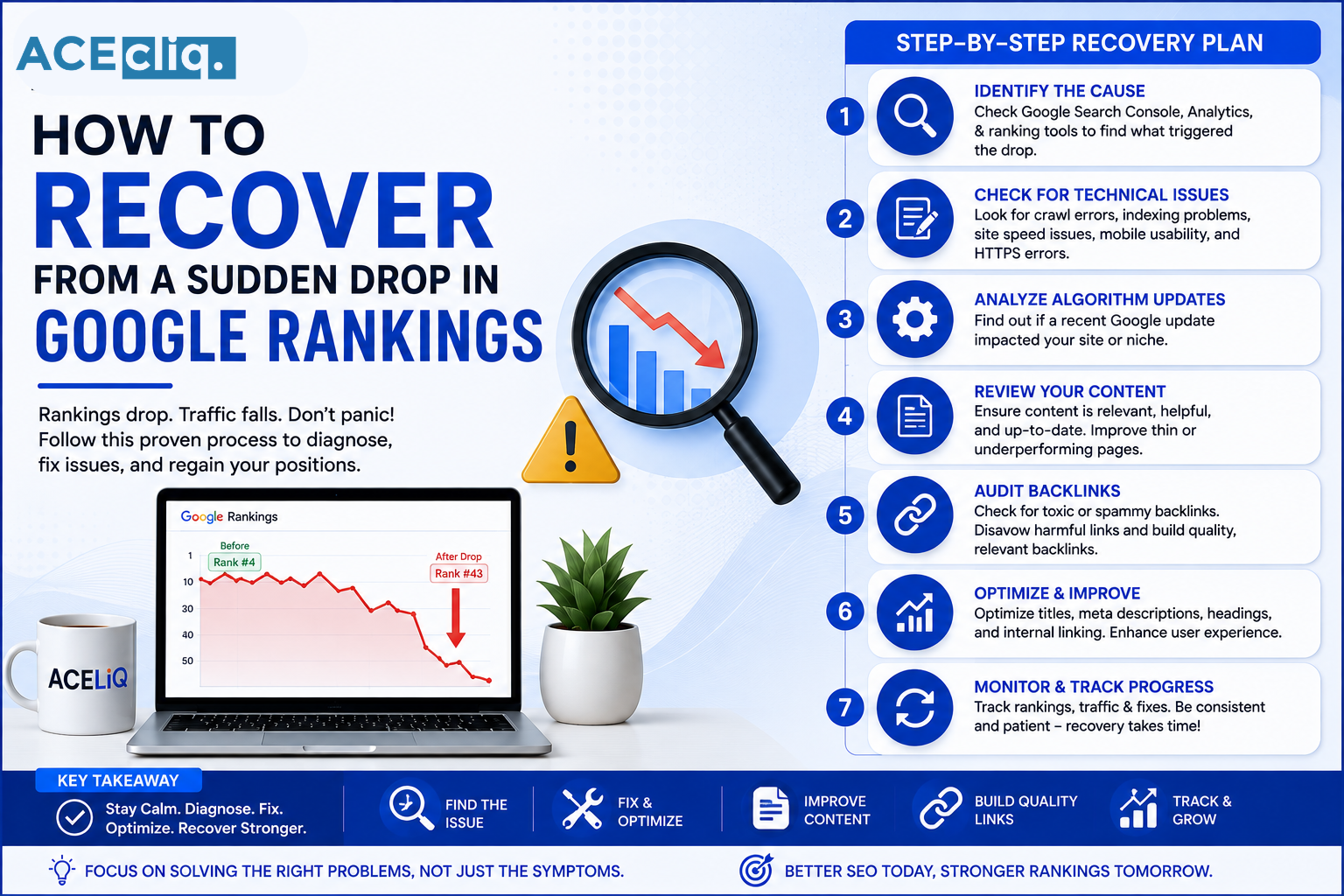
The most important response is not to panic and make random changes. Instead, identify exactly when the decline happened, which pages and keywords were affected, and what changed around the same time.
At ACECLiQ, we use structured SEO analysis to diagnose ranking declines and develop recovery strategies based on the actual cause rather than assumptions.
AI Overview
A sudden drop in Google rankings can happen because of algorithm changes, technical SEO problems, indexing issues, content quality concerns, website changes, backlink losses, or increased competition. The first step is to determine whether the decline affects specific pages, keywords, devices, or the entire website. Businesses should use Google Search Console and analytics data to identify when the drop occurred and investigate possible causes before making major changes. A structured SEO ranking recovery process should address the actual problem, improve affected pages, resolve technical issues, and monitor performance over time.
Why Do Google Rankings Suddenly Drop?
A Google ranking drop can have several causes, and identifying the right one is the first step toward recovery.
Sometimes the problem is technical. A website redesign may accidentally introduce noindex tags, broken redirects, canonical problems, or crawl restrictions. In other situations, content may no longer satisfy the intent behind a search query.
Algorithm updates can also change how Google evaluates pages. Meanwhile, competitors may publish better resources, earn stronger links, or improve their overall user experience.
A decline in rankings can therefore be caused by your website, Google's search systems, competitors, or a combination of factors.
Check Google Search Console First
When organic performance suddenly falls, Google Search Console should be one of the first places you investigate. Open the Performance report and compare the period before and after the decline. Look at clicks, impressions, average position, and queries to determine the nature of the change.
If impressions and clicks both decline, your website may have lost visibility for important searches. If impressions remain relatively stable but clicks fall, changes in search results or click-through rate may be contributing to the problem. Analyze the affected pages individually rather than assuming that every page has been impacted equally.
Determine Whether It Is a Google Algorithm Update

If multiple pages and keywords declined around the same time, investigate whether Google released a significant ranking update. A broad algorithm change can affect websites differently depending on their content quality, relevance, authority, and overall search experience.
Do not immediately rewrite your entire website simply because rankings changed. First, identify which types of pages declined and compare their performance with pages that remained stable. This can reveal patterns that help determine whether the issue is related to content, technical SEO, search intent, or broader changes in search results.
Check for Technical SEO Problems
Technical problems can cause significant ranking losses even when your content has not changed. Review your website for issues involving crawling, indexing, redirects, canonical URLs, robots.txt, XML sitemaps, server errors, and page accessibility.
Pay particular attention to recent website development work. A redesign, migration, URL change, CMS update, or plugin modification can unintentionally affect search visibility. A detailed Technical SEO investigation should establish whether Google can still crawl and index your important pages correctly.
Review Recent Website Changes
Think about what changed immediately before the ranking decline. Did you redesign the website? Change URLs? Update page content? Modify internal links? Remove pages? Change your domain? Install a new plugin? Alter your robots.txt file?
Even seemingly small changes can affect organic performance. Create a timeline showing when the website changes occurred and when rankings began declining. If the dates closely correspond, investigate those changes before making additional modifications.
Analyze Content Quality and Search Intent
Sometimes the website is technically healthy, but its content is no longer the strongest result for a particular query. Search intent can evolve over time. A query that previously favored long-form informational content might increasingly show product pages, comparison pages, videos, local results, or other formats.
Review the pages currently ranking for your important keywords.
Ask whether your page:
- Directly answers the user's question
- Provides enough useful information
- Demonstrates relevant expertise
- Is current and accurate
- Offers a better experience than competing pages
Improving content should focus on usefulness rather than simply adding more words.
Check Lost Backlinks and Competitor Changes
Backlinks can contribute to a website's authority and visibility. If important pages have recently lost valuable backlinks, investigate whether this coincides with ranking declines.
At the same time, examine your competitors. A ranking decline does not always mean your website becomes worse. Another website may simply have become more relevant or authoritative. Compare competing pages for content depth, search intent, internal linking, user experience, topical coverage, and authority.
This competitive analysis can reveal opportunities that your previous SEO strategy overlooked.
Review Indexing and Crawl Issues
One of the most serious SEO problems occurs when important pages stop being indexed. Use Google Search Console to inspect affected URLs and verify whether Google can access and index them.
Check whether pages are affected by:
- noindex directives
- Incorrect canonical tags
- Robots.txt restrictions
- Server errors
- Redirect problems
- Duplicate URL issues
If a previously ranking page is no longer indexed, fixing the indexing problem should take priority over content optimization.
Recover Rankings Step by Step
Once you understand the likely cause, create a Google Penalty Recovery plan instead of changing everything simultaneously.
Start with critical technical problems. Make sure important pages are crawlable, indexable, accessible, and correctly configured.
Next, review affected content and compare it with current search results. Improve outdated information, strengthen topical coverage, address unanswered questions, and make the page more useful for its intended audience.
Then review internal links and connect important pages with relevant supporting content.
Finally, monitor performance over the following weeks and months. SEO recovery is rarely instantaneous, and making too many changes at once can make it difficult to determine which improvements actually worked.
What Not to Do After a Ranking Drop
One of the biggest mistakes businesses make is reacting emotionally.
Do not immediately delete large amounts of content, change every title tag, build hundreds of backlinks, or rewrite your entire website without understanding the problem.
Avoid keyword stuffing and low-quality content designed solely to recover rankings.
Do not assume that every ranking decline is a Google penalty either.
The correct strategy is diagnosis first, implementation second, and measurement third.
How to Prevent Future Ranking Drops
SEO recovery is important, but prevention is even better. Businesses should regularly monitor Google Search Console, organic traffic, important keyword groups, indexing status, website performance, and technical health. Keep important content updated and regularly review whether pages continue to satisfy search intent.
A strong internal linking structure, reliable technical foundation, high-quality content, and consistent SEO monitoring make websites more resilient when search algorithms and competitive conditions change.
Final Conclusion
Knowing How to Recover From a Sudden Drop in Google Rankings starts with understanding that ranking declines can have many different causes. Technical problems, indexing issues, algorithm changes, content quality, search intent, backlink losses, and competitor activity should all be investigated before taking corrective action.
The most effective recovery strategy is systematic: identify when the decline started, determine which pages and queries were affected, diagnose the underlying cause, implement targeted improvements, and monitor the results.
At ACECLiQ, we help businesses diagnose Google ranking drops, identify technical and content-related problems, and develop data-driven SEO recovery strategies designed to restore search visibility, improve organic traffic, and build a stronger foundation for long-term growth.