
Google Ads vs SEO: Which is Better for Business Growth in 2026? | ACECLiQ
In today’s competitive digital landscape, every business aims to increase website traffic, generate quality leads, and boost revenue. The real challenge lies in deciding where to invest your marketing budget for the best results. Two of the most powerful strategies available are Search Engine Optimization (SEO) and Google Ads.
Business owners often face a common dilemma: Should you invest in SEO or run Google Ads?
The answer depends on your goals, budget, timeline, and level of competition in your industry. While both strategies can drive targeted traffic and generate leads, they operate in fundamentally different ways.
This ACECLiQ's guide will help you understand the key differences between SEO and Google Ads, their benefits and limitations, and how to choose the right approach for your business growth.
AI Overview
Google Ads and SEO are two of the most effective digital marketing strategies available to businesses today. While Google Ads provides immediate visibility through paid placements, SEO focuses on improving organic search rankings for sustainable long-term growth. Understanding the differences between cost, speed, ROI, traffic quality, and lead generation can help businesses choose the right strategy—or combine both—to maximize online success.
What is SEO?
Search Engine Optimization (SEO) is the process of improving your website’s visibility in organic search results.
When users search for products, services, or information related to your business, SEO helps your website rank higher without paying for each click.
SEO typically includes:
- Keyword research
- Content creation
- Technical optimization
- Link building
- Local SEO
- User experience improvements
The goal is to attract relevant visitors who are actively searching for what your business offers.
Example
If someone searches:
"Best Digital Marketing Agency in Lucknow"
A well-optimized website can appear on the first page of search results and receive traffic without paying for each visitor.
What are Google Ads?
Google Ads is a paid advertising platform that allows businesses to appear at the top of search results instantly.
Instead of earning rankings organically, advertisers bid on keywords and pay whenever users click on their ads.
Google Ads enables businesses to:
- Generate traffic instantly
- Target specific keywords
- Control advertising budgets
- Reach customers at the right moment
- Track conversions accurately
For businesses that need quick results, Google Ads can be highly effective.
Example
If you bid on:
"Digital Marketing Company in Delhi"
Your ad can appear above organic results within hours of launching your campaign.
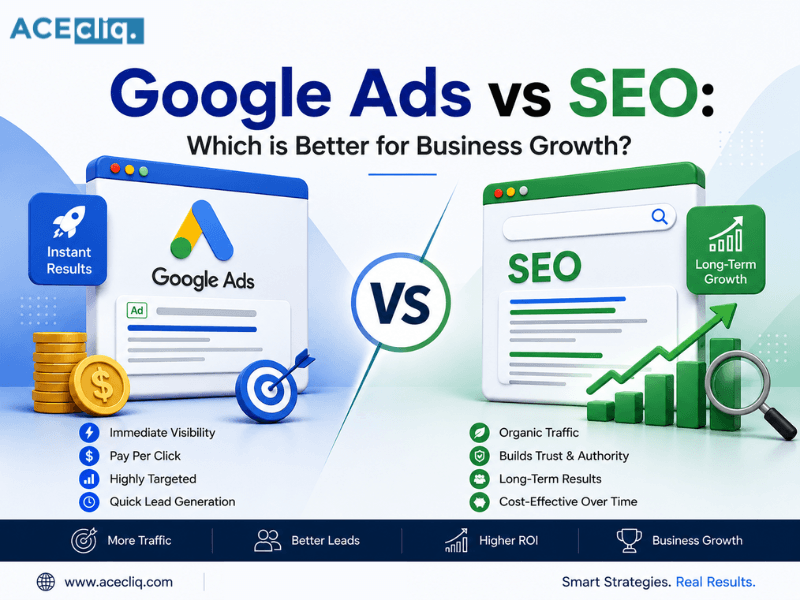
SEO vs Google Ads: Understanding the Core Difference
The primary difference lies in how traffic is generated.
SEO
- Organic traffic
- Long-term strategy
- No cost per click
- Requires continuous optimization
- Builds authority over time
Google Ads
- Paid traffic
- Immediate visibility
- Pay-per-click model
- Requires ongoing budget
- Stops generating traffic when ads stop
SEO is like building a long-term asset, while Google Ads is like renting visibility.
Traffic Generation: Which Delivers Better Results?
Traffic quality often matters more than quantity.
SEO Traffic
Organic visitors tend to trust search results more than advertisements.
Benefits include:
- Higher trust levels
- Better engagement
- Consistent long-term traffic
- Stronger brand authority
SEO traffic can continue for months or even years after content is published.
Google Ads Traffic
Paid traffic delivers immediate results.
Benefits include:
- Instant visibility
- Scalable campaigns
- Faster testing opportunities
- Highly targeted audience
However, traffic stops as soon as the ad budget is paused.
Winner
SEO is better for long-term traffic, while Google Ads is ideal for immediate results.
Lead Generation Comparison
For most businesses, lead generation is more important than traffic alone.
SEO Leads
SEO attracts users who are researching solutions.
These users often:
- Spend more time evaluating options
- Compare multiple providers
- Convert later in the buying journey
SEO leads are often highly qualified due to their intent.
Google Ads Leads
Google Ads targets users with strong purchase intent.
These users typically:
- Need immediate solutions
- Are ready to take action
- Have high commercial intent
Google Ads can generate leads much faster.
Winner
Google Ads is better for quick lead generation, while SEO is more effective for long-term lead acquisition.
Cost Comparison
Budget plays a crucial role in choosing the right strategy.
SEO Costs
SEO requires investment in:
- Content creation
- Website optimization
- Technical improvements
- Link building
- Ongoing management
Although SEO requires upfront effort, it becomes more cost-effective over time.
Google Ads Costs
Google Ads operates on a pay-per-click model.
Costs depend on:
- Keyword competition
- Industry demand
- Target location
- Campaign quality
Highly competitive industries often have higher click costs.
Winner
SEO generally offers better long-term cost efficiency.
Time Required to See Results
Speed is a key factor in decision-making.
SEO Timeline
SEO takes time to deliver results.
Most businesses start seeing improvements within:
- 3 to 6 months
- Longer in competitive markets
Building authority requires consistency and patience.
Google Ads Timeline
Google Ads can generate traffic almost immediately.
Campaign performance can be tracked within hours or days.
Winner
Google Ads is the clear choice for immediate results.
Trust and Credibility
Trust plays a major role in customer decisions.
Many users prefer organic results over paid ads because they are seen as more credible.
Businesses that rank organically often gain:
- Higher trust
- Stronger authority
- Better brand perception
While Google Ads increases visibility, SEO builds long-term credibility.
Winner
SEO
Brand Awareness and Market Authority
Consistent visibility in organic search results helps businesses establish authority.
SEO contributes to:
- Industry expertise
- Brand recognition
- Customer trust
- Thought leadership
Google Ads increases exposure but does not automatically build authority.
Winner
SEO
Measuring ROI
Return on Investment (ROI) is a critical factor in marketing decisions.
SEO ROI
SEO delivers long-term benefits.
A well-ranking page can generate leads for years without additional advertising costs, resulting in strong ROI over time.
Google Ads ROI
Google Ads provides measurable and immediate results.
You can track:
- Clicks
- Conversions
- Cost per lead
- Revenue
Campaigns can be optimized quickly for better performance.
Winner
Both strategies can deliver strong ROI when executed effectively.
Which Strategy Works Best for Small Businesses?
Small businesses often have limited budgets, making strategic decisions essential.
Choose SEO If:
- You want long-term growth
- You have a limited budget
- You aim for sustainable traffic
- Building brand authority is important
Choose Google Ads If:
- You need immediate leads
- You are launching a new business
- You are running time-sensitive campaigns
- You want to test market demand
Why Combining SEO and Google Ads Produces the Best Results
Successful businesses often use both SEO and Google Ads together.
Benefits of combining both include:
- Immediate visibility through ads
- Long-term growth through SEO
- Increased search result coverage
- Better keyword insights
- Higher conversion opportunities
This approach creates a well-rounded digital marketing strategy.
Example
A business can:
- Use Google Ads for instant lead generation
- Invest in SEO for long-term growth
- Analyze ad data to improve SEO content
This combination leads to stronger overall performance.
Common Mistakes Businesses Make
1. Relying Only on Paid Ads
Depending solely on ads can be risky. Once the budget stops, traffic and leads often disappear.
2. Expecting Instant SEO Results
SEO requires time and consistent effort. Unrealistic expectations can lead to disappointment.
3. Ignoring Conversion Optimization
Driving traffic is not enough. Landing pages, user experience, and clear calls-to-action are essential for conversions.
4. Focusing Only on Rankings
Higher rankings are important, but the ultimate goal should be generating revenue and business growth.
Final Conclusion: Which is Better for Business Growth?
The comparison between SEO and Google Ads is not about choosing one over the other. It is about selecting the right strategy based on your business goals. If you need immediate visibility, fast lead generation, and quick testing, Google Ads is the right choice. If your focus is long-term growth, sustainable traffic, higher trust, and stronger authority, SEO is the better investment.
For most businesses, the most effective approach is to combine both strategies.
Google Ads can deliver immediate results, while SEO builds a strong foundation for future growth. Businesses that leverage both channels create a powerful digital presence, attract more qualified customers, and achieve consistent success over time.
At ACECLiQ, we help businesses implement data-driven SEO and Google Ads strategies that drive measurable growth, improve visibility, and maximize return on investment in today’s competitive digital environment.