
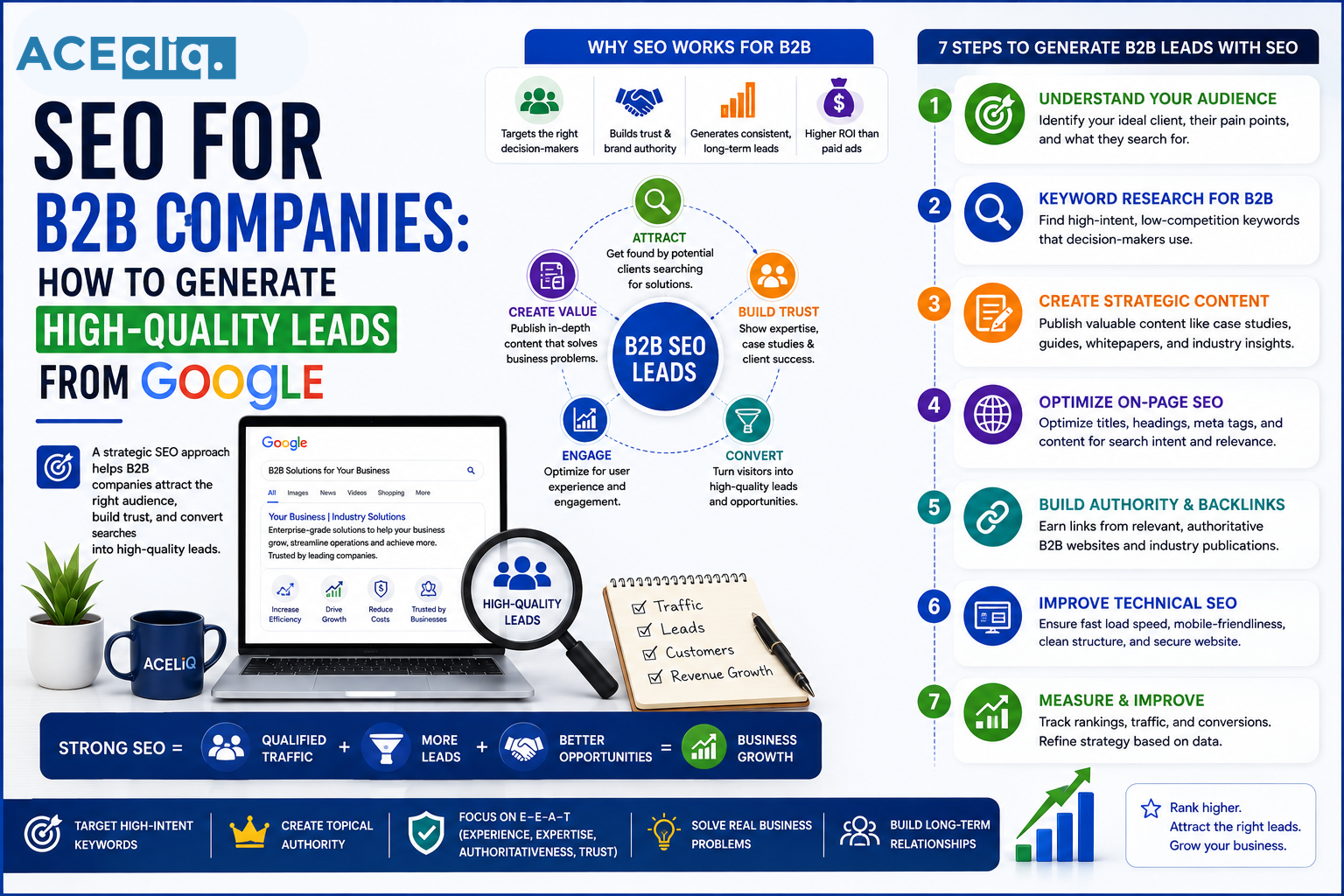
SEO for B2B Companies: How to Generate High-Quality Leads From Google
For B2B companies, generating leads from Google requires a different approach from traditional consumer-focused SEO. A B2B buyer may search for information several times before contacting a company, compare multiple providers, consult colleagues, and evaluate pricing, expertise, implementation, and long-term value.
This makes SEO for B2B Companies more than a strategy for increasing website traffic. The real objective is to attract the right businesses, reach relevant decision-makers, demonstrate expertise, and move qualified prospects toward a sales conversation.
A successful B2B SEO strategy connects search visibility with the entire buyer journey. It combines keyword research, search intent, high-quality content, technical optimization, service pages, internal linking, authority building, and conversion optimization.
At ACECLiQ, we help B2B businesses build search strategies focused not just on rankings, but on attracting relevant prospects and generating measurable business opportunities.
AI Overview
SEO for B2B Companies is a long-term strategy for attracting decision-makers and qualified prospects through organic search. Unlike consumer SEO, B2B SEO often involves longer buying cycles, multiple decision-makers, specialized products or services, and highly specific search queries. A successful B2B SEO strategy combines commercial keyword research, search-intent optimization, authoritative content, technical SEO, service-page optimization, internal linking, and conversion-focused landing pages. By aligning content with the B2B buyer journey, companies can attract relevant Google traffic and turn organic visibility into qualified business leads.
What Is B2B SEO?
B2B SEO is the process of optimizing a business website to attract companies and professional buyers through organic search engines. The objective is not simply to rank for high-volume keywords. A successful B2B SEO campaign focuses on searches made by people who could realistically become customers.
For example, a software company might target searches related to its software category, implementation requirements, industry problems, integrations, comparisons, and specific use cases. This creates opportunities to reach potential buyers at different stages of their research process.
Why SEO Matters for B2B Companies
B2B purchasing decisions often begin with research. Potential customers may search Google to understand a problem, explore possible solutions, compare vendors, or find specialists.
If your business appears during these searches, you have an opportunity to introduce your expertise before a prospect contacts a competitor. A strong B2B SEO Strategy can help companies increase organic visibility, attract relevant website visitors, establish industry authority, generate qualified leads, and reduce dependence on paid acquisition.
The key is to focus on the quality and commercial relevance of traffic rather than simply maximizing visitor numbers.
Understand the B2B Buyer Journey
B2B customers rarely move directly from a Google search to a purchase.
The journey can involve several stages.
At the awareness stage, a potential buyer is trying to understand a problem. At the consideration stage, they research possible solutions. At the evaluation stage, they compare providers, features, pricing, and expertise.
Finally, they may search for a specific company or service before making contact.
Your SEO strategy should provide useful content at each stage.
This creates a connected B2B Lead Generation Strategy instead of relying on a small number of commercial keywords.
Find High-Intent B2B Keywords
Keyword research is one of the foundations of B2B SEO. However, search volume should not be the only consideration. A keyword with 100 monthly searches from highly qualified decision-makers may be more valuable than a keyword with thousands of searches from people who have no intention of becoming customers.
Focus on keywords that demonstrate relevance and commercial intent.
These may include terms such as:
- B2B SEO services
- Enterprise software solutions
- Industrial equipment suppliers
- B2B marketing agency
- Business consulting services
- Industry-specific solutions
Your keyword strategy should also include informational searches that potential customers use during their research.
Create Content for Every Buying Stage
Content is one of the most effective ways to support a B2B buyer throughout the decision process. Educational blog posts can attract users researching problems, while detailed guides can help prospects understand possible solutions.
Comparison pages can support evaluation, while case studies demonstrate how your business has solved real customer problems. Service pages and product pages should target users who are closer to taking action.
A strong B2B Content Marketing strategy connects all these formats into one journey.
Create Problem-Solving Content
B2B buyers often search for solutions to specific business problems rather than immediately searching for a company. For example, a manufacturing company may search for ways to reduce production costs before searching for a specific supplier.
Creating useful content around these problems gives your business an opportunity to enter the conversation early. The content should explain the problem clearly, provide practical guidance, and naturally introduce relevant solutions when appropriate.
This approach builds trust before the sales conversation begins.
Optimize B2B Service and Product Pages
Your service and product pages are often the most commercially important pages on your website. They should clearly explain what you offer, who it is for, what problems it solves, and why your company is qualified to provide it.
Avoid creating generic pages that contain only a short description and a contact button. A strong B2B landing page can include service details, use cases, industries served, benefits, implementation information, customer evidence, FAQs, and clear calls to action. These elements help both search engines and potential customers understand the value of your offering.
Build Topical Authority
B2B companies can strengthen their organic visibility by developing comprehensive coverage around their core areas of expertise. Instead of publishing unrelated articles, organize content into logical Topic Clusters.
For example, a B2B SEO agency could create a central resource about B2B SEO supported by articles covering B2B keyword research, enterprise SEO, B2B content marketing, lead generation, technical SEO, conversion optimization, and SEO measurement. Relevant internal links connect these resources and create a stronger topical structure.
Strengthen Technical SEO
Even excellent B2B content can struggle if search engines cannot efficiently crawl, index, or understand your website. A strong technical foundation should include proper website architecture, HTTPS, crawlable pages, appropriate canonicalization, XML sitemaps, mobile usability, structured data where relevant, and strong page performance.
Technical SEO should also be reviewed after website migrations, redesigns, URL changes, or major development updates. A technically healthy website creates a stronger foundation for your broader B2B Search Engine Optimization strategy.
Use Internal Linking Strategically
B2B websites often have many service pages, product pages, industry pages, and educational resources. Without proper internal linking, valuable pages can become difficult for users and search engines to discover.
Connect related content naturally. An article about B2B lead generation could link to a detailed page about conversion optimization. A Technical SEO guide could link to your SEO audit service. Use descriptive anchor text that helps users understand what they will find after clicking.
This creates a better website experience while strengthening relationships between related topics.
Build B2B Backlinks and Authority
High-quality Backlinks can strengthen the authority of your website. For B2B businesses, relevant links can come from industry publications, trade associations, professional organizations, business publications, research websites, partners, and reputable industry blogs.
Instead of focusing on acquiring large numbers of low-quality links, create resources that deserve to be referenced. Original research, industry reports, detailed guides, case studies, statistics, and expert commentary can all create legitimate link opportunities.
Authority building should be relevant to your industry and sustainable over the long term.
Optimize for B2B Conversions

Ranking on Google is only part of the process. Your website needs to make it easy for qualified prospects to take the next step. Depending on your business model, this might mean requesting a quote, booking a consultation, scheduling a demonstration, downloading a resource, or contacting a sales representative.
Calls to action should be relevant to the visitor's stage in the buying journey. A first-time visitor may not be ready to request a sales call, while someone reading a detailed service page may be ready to speak with your team.
Effective B2B Conversion Optimization aligns the call to action with user intent.
Demonstrate Expertise and Trust
B2B buyers need confidence before making business decisions. Your website should clearly demonstrate why your company is qualified to solve the customer's problem. Use case studies, client results, expert authorship, certifications where relevant, testimonials, original insights, and transparent company information to demonstrate credibility.
Content should also be accurate and regularly reviewed.For B2B businesses, expertise is not just an SEO consideration. it is an important part of the sales process.
Measure B2B SEO Performance
A successful SEO campaign should be measured against business outcomes. Track organic impressions and clicks, but go further by monitoring qualified leads, lead conversion rates, landing-page performance, assisted conversions, and revenue influenced by organic search.
You should also evaluate which keywords and pages generate the highest-quality prospects. A page that attracts fewer visitors but consistently generates qualified inquiries may be more valuable than a high-traffic informational article. This is why B2B SEO Services should focus on revenue-related outcomes rather than rankings alone.
Common B2B SEO Mistakes
One common mistake is targeting keywords purely because they have high search volume.
Another is creating large amounts of generic content that does not demonstrate industry expertise.
B2B companies may also overlook commercial landing pages while investing heavily in informational blogs.
Other problems include weak internal linking, slow websites, unclear calls to action, duplicate location or industry pages, and failure to track lead quality.
The solution is to connect SEO strategy directly to customer needs and business objectives.
A Practical B2B SEO Strategy
A practical approach begins with understanding your ideal customer and mapping their buying journey. Research the problems they experience, the questions they ask, and the solutions they evaluate. Then develop a keyword map that includes informational, commercial, and transactional searches.
Create pillar content and supporting resources around your most important subjects. Optimize your service pages, strengthen internal linking, improve technical SEO, and build authority through genuinely valuable resources. Finally, track qualified leads and conversions and continuously improve pages based on performance.
This creates a sustainable B2B Marketing Strategy instead of a short-term traffic campaign.
Final Conclusion
SEO for B2B Companies is most effective when search optimization is connected to the complete customer journey. The goal is not simply to rank for more keywords. It is to appear when relevant decision-makers are researching problems, evaluating solutions, comparing providers, and looking for businesses they can trust.
By combining high-intent keyword research, useful content, topical authority, technical SEO, strategic internal linking, authoritative backlinks, and conversion-focused landing pages, B2B companies can turn Google into a consistent source of qualified business opportunities.
At ACECLiQ, we build data-driven B2B SEO strategies focused on attracting the right audience, improving organic visibility, generating qualified leads, and creating sustainable long-term growth.