
What Is Keyword Cannibalization? How to Find and Fix It
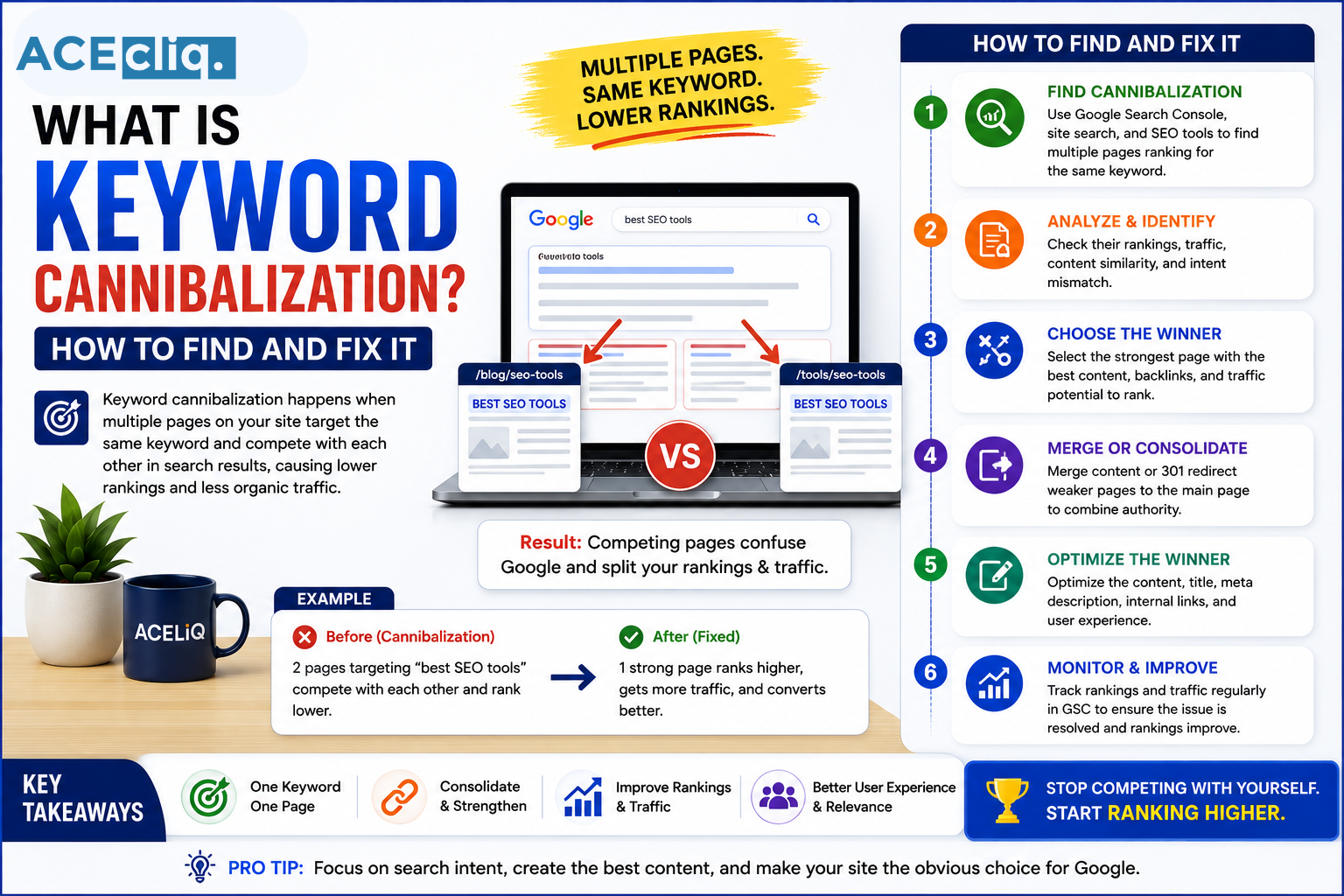
Creating multiple pages around related keywords can be an effective way to build topical authority. However, problems can arise when several pages target the same search intent without a clear reason for existing separately. This situation is commonly described as Keyword Cannibalization.
When multiple URLs are competing for similar queries, search engines may have difficulty determining which page is the strongest result. This can lead to ranking fluctuations, inconsistent traffic, or a different page ranking than the one you intended. Understanding and resolving Keyword Cannibalization SEO issues is therefore an important part of maintaining a well-organized website.
At ACECLiQ, we analyze keyword targeting, search intent, content structure, internal links, and ranking URLs to identify overlapping pages and develop practical solutions that strengthen overall organic performance.
AI Overview
Keyword cannibalization occurs when multiple pages on the same website target the same or very similar search intent, potentially making it difficult for search engines to determine which page should rank. It can result in fluctuating rankings, divided backlinks and internal authority, or the wrong page appearing for a query. To identify potential cannibalization, compare ranking URLs and their target queries in Google Search Console and other SEO tools. Solutions may include improving search intent differentiation, consolidating overlapping content, redirecting redundant pages, or strengthening internal linking.
How Keyword Cannibalization Happens
Keyword cannibalization usually develops as a website grows.
A business may publish an article targeting a keyword and later create another article around a closely related phrase without realizing that both pages satisfy essentially the same search intent.
For example, a website might have separate articles targeting:
"SEO Audit"
and
"SEO Website Audit"
If both pages provide almost identical information and target the same audience, they may compete rather than complement each other.
The problem is not that the keywords are similar. The real issue is overlapping intent and content purpose.
Is Keyword Cannibalization Always Bad?
Not necessarily.
Multiple pages can rank for similar keywords when they serve different purposes.
For example, a website could have:
- An informational guide explaining SEO audits
- A dedicated SEO audit service page
- A case study showing the results of an audit
These pages may target related terms while satisfying different user needs.
Therefore, you should not automatically merge pages simply because they contain similar keywords.
The first question should always be:
Do these pages satisfy the same search intent?
If the answer is yes, further investigation may be necessary.
Signs Your Website Has Keyword Cannibalization
There are several warning signs that may indicate competing pages. One common sign is ranking volatility. Two URLs may repeatedly switch positions for similar queries. Another is seeing the wrong page appear in Google for a keyword. For example, you may want your service page to rank for a commercial query, but an old blog post appears instead.
You may also notice that several pages receive impressions for the same group of queries without any page becoming a clear primary result. These patterns do not automatically prove cannibalization, but they are strong reasons to investigate.
How to Find Keyword Cannibalization
Finding potential Keyword Cannibalization requires looking at relationships between keywords, URLs, and search intent.
Start by creating a keyword-to-page map for your important topics.Record which page is intended to rank for each primary keyword and related keyword group.
Then compare this map with actual search performance.
If multiple URLs consistently appear for the same important queries, examine whether they genuinely need to exist separately.
Use Google Search Console
Google Search Console is one of the most useful sources for identifying potential cannibalization. Open the Performance report and examine your important search queries. Select a query and review the Pages tab to see which URLs have received impressions and clicks for that search. If multiple pages appear for the same query, investigate their content and intent.
Do not assume that multiple URLs appearing for one query automatically means there is a problem. Google may legitimately rank different pages from the same website for related searches. The important question is whether your website structure clearly communicates which page is the best resource for each intent.
Analyze Your Keyword Map
A well-organized keyword map can prevent cannibalization before it happens.
Assign each major keyword group to a specific URL based on its purpose.
For example, a digital marketing agency might map:
"SEO services" → SEO service page
"What is SEO?" → Educational guide
"SEO audit" → SEO audit service or dedicated informational guide
This creates clearer differentiation between pages.
Keyword mapping also helps content teams identify gaps without unnecessarily creating new pages for subjects already covered.
Compare Search Intent
Search intent is at the center of most cannibalization decisions.
Two keywords may look different but represent almost exactly the same user need.
Likewise, two pages may contain similar terminology but serve completely different purposes.
Review the current search results for the target query.
Look at the types of pages Google ranks.
Are they service pages, product pages, guides, comparisons, category pages, or local results?
Your content should match the dominant intent rather than simply targeting the keyword.
How to Fix Keyword Cannibalization

There is no single solution for every cannibalization issue. The correct approach depends on why the pages overlap and whether each URL has independent value.
Possible solutions include:
Content consolidation when two pages provide almost identical information.
Content differentiation when both pages are valuable but their purposes need to be clearer.
301 redirects when one page is redundant and its value should be transferred toward another relevant URL.
Canonicalization when similar pages need to remain accessible but one version should be treated as the preferred canonical URL.
Internal linking improvements when your website needs clearer relationships between related pages.
When to Merge Content
Merging content can be effective when two pages target the same search intent and one combined resource would provide greater value. For example, imagine you have two articles about SEO audits that cover almost identical information.
Instead of maintaining two weakly differentiated pages, you could combine the strongest information into one comprehensive resource. After consolidation, redirect the weaker URL to the preferred page when appropriate.
The goal is to create one stronger resource rather than two competing ones.
When to Use a 301 Redirect
A 301 Redirect can be appropriate when an old or redundant page has no reason to exist separately and its relevant value should be consolidated into another URL.
Before redirecting a page, make sure the destination is genuinely relevant. Do not redirect unrelated pages simply to pass users or search engines somewhere else. A redirect should create a logical journey for visitors and preserve useful relationships between old and new URLs.
Improve Internal Linking
Internal linking can help communicate which pages are most important for particular topics. If several articles discuss a broad subject, use relevant internal links to connect them to the appropriate pillar or primary page.
For example, several supporting articles about SEO could link naturally to a central SEO guide. Use descriptive anchor text that accurately communicates what the destination page covers. Internal linking cannot magically eliminate cannibalization, but it can contribute to a clearer website architecture.
Use Canonical Tags Correctly
Canonical tags can help communicate a preferred version among substantially similar or duplicate URLs. However, canonicalization should not be treated as a universal solution for pages with different search intents.
If two pages are genuinely different resources that deserve to rank independently, choosing one canonical URL simply because the keywords overlap may be inappropriate. Use canonical signals carefully and ensure they accurately reflect your website's intended URL structure.
Differentiate Similar Content
Sometimes two pages should remain separate. For example, an article explaining SEO pricing and a service page offering SEO services may target related terminology but satisfy different user needs. Instead of merging them, strengthen the distinction.
The informational article can explain pricing models, factors affecting cost, and budgeting considerations. The service page can explain your services, process, expertise, and how prospects can contact your business. Clear differentiation allows both pages to serve useful roles within the customer journey.
Prevent Future Keyword Cannibalization

Prevention is easier than fixing a website with hundreds of overlapping pages. Before creating new content, check whether your website already has a page covering the subject. If one exists, ask whether it should be updated rather than creating another URL.
Maintain a centralized keyword map and assign each major topic to an appropriate page. Your content calendar should also include existing-page updates and consolidation opportunities, not just new articles. This creates a more efficient SEO Content Strategy.
Keyword Cannibalization and Topical Authority
Businesses sometimes assume that publishing multiple articles about the same subject automatically creates topical authority.
It doesn't. Topical authority comes from useful, relevant, and well-organized coverage, not simply the number of URLs on a website.
A strong website should have clear relationships between its pillar pages and supporting content. Every page should have a distinct purpose. This creates a cleaner content ecosystem and helps users find the most appropriate resource for their needs.
Final Conclusion
Keyword Cannibalization is not simply a situation where two pages contain the same keyword. The real concern is whether multiple pages are competing for the same search intent without a clear reason to exist separately.
The best way to identify potential problems is to analyze ranking URLs, search queries, content purpose, and user intent together. When overlap exists, the solution may involve consolidating content, differentiating pages, improving internal links, implementing appropriate redirects, or restructuring your keyword map. A well-organized website gives every important page a clear purpose.
At ACECLiQ, we help businesses identify and resolve SEO Cannibalization issues while building a clearer content architecture designed to improve organic visibility, strengthen topical relevance, and support long-term SEO growth.