
What Is Topical Authority in SEO? How to Build It Step by Step
Search engine optimization has evolved beyond targeting individual keywords. Today, businesses need to demonstrate genuine knowledge and depth across the subjects they want to rank for. Publishing one article about a topic may help a website target a particular search query, but a well-organized collection of useful, interconnected content can provide much broader coverage.
This is the foundation of Topical Authority in SEO.
Topical authority is built when a website consistently creates valuable content around a specific subject and its related subtopics. Instead of treating every blog post as a separate SEO opportunity, businesses can create a connected content ecosystem that answers different questions throughout the customer journey.
For example, a digital marketing website could build topical authority around SEO by covering technical SEO, on-page SEO, local SEO, keyword research, SEO audits, Core Web Vitals, content optimization, link building, SEO KPIs, and search intent.
At ACECLiQ, we use topic-focused content planning, semantic relationships, strategic internal linking, and search-intent analysis to help businesses develop stronger organic visibility.
AI Overview
Topical Authority in SEO refers to the depth, relevance, and overall coverage a website demonstrates around a specific subject. Instead of publishing isolated articles targeting individual keywords, businesses build authority by creating interconnected content that covers a topic and its important subtopics comprehensively. A strong topical SEO strategy combines pillar content, topic clusters, search intent, semantic relevance, internal linking, and high-quality supporting content. Building topical authority can help search engines better understand a website's expertise while creating a more useful experience for visitors.
What Is Topical Authority in SEO?
Topical Authority is the level of expertise and comprehensive coverage a website demonstrates about a particular subject.
Imagine two websites competing for the same SEO-related search.
Website A has one general article about SEO.
Website B has dozens of useful resources covering technical SEO, keyword research, on-page optimization, content strategy, local SEO, link building, SEO audits, analytics, and related subjects.
Website B provides much greater topical coverage.
The objective is not simply to publish as many articles as possible. Every piece of content should have a clear purpose, satisfy a specific search intent, and contribute to the broader subject.
Why Topical Authority Matters for SEO
Search engines need to determine which content is most relevant and useful for a user's query.
A website that consistently demonstrates knowledge across related subjects provides stronger contextual signals than a site with disconnected articles.
A strong Topical SEO strategy can help businesses improve content relevance, target a wider range of related searches, strengthen internal linking, and create better user journeys.
It can also help businesses move from targeting individual keywords toward establishing authority around entire subject areas.
However, topical authority should not be viewed as a guaranteed ranking formula. Search rankings depend on many factors, including relevance, content quality, technical accessibility, user experience, competition, and overall site quality.
Topical Authority vs Domain Authority
Topical authority and domain authority are often confused, but they represent different concepts.
Topical authority focuses on how comprehensively and credibly a website covers a particular subject.
Domain authority, on the other hand, is commonly used as a third-party SEO metric to estimate the strength of a website's backlink profile. It is not a Google ranking score.
A website can have strong authority in one subject without being an expert in every industry.
For example, a website may have extensive content about digital marketing but limited relevance in medical or financial subjects.
This is why businesses should build authority around topics that directly align with their expertise and services.
How Topic Clusters Work
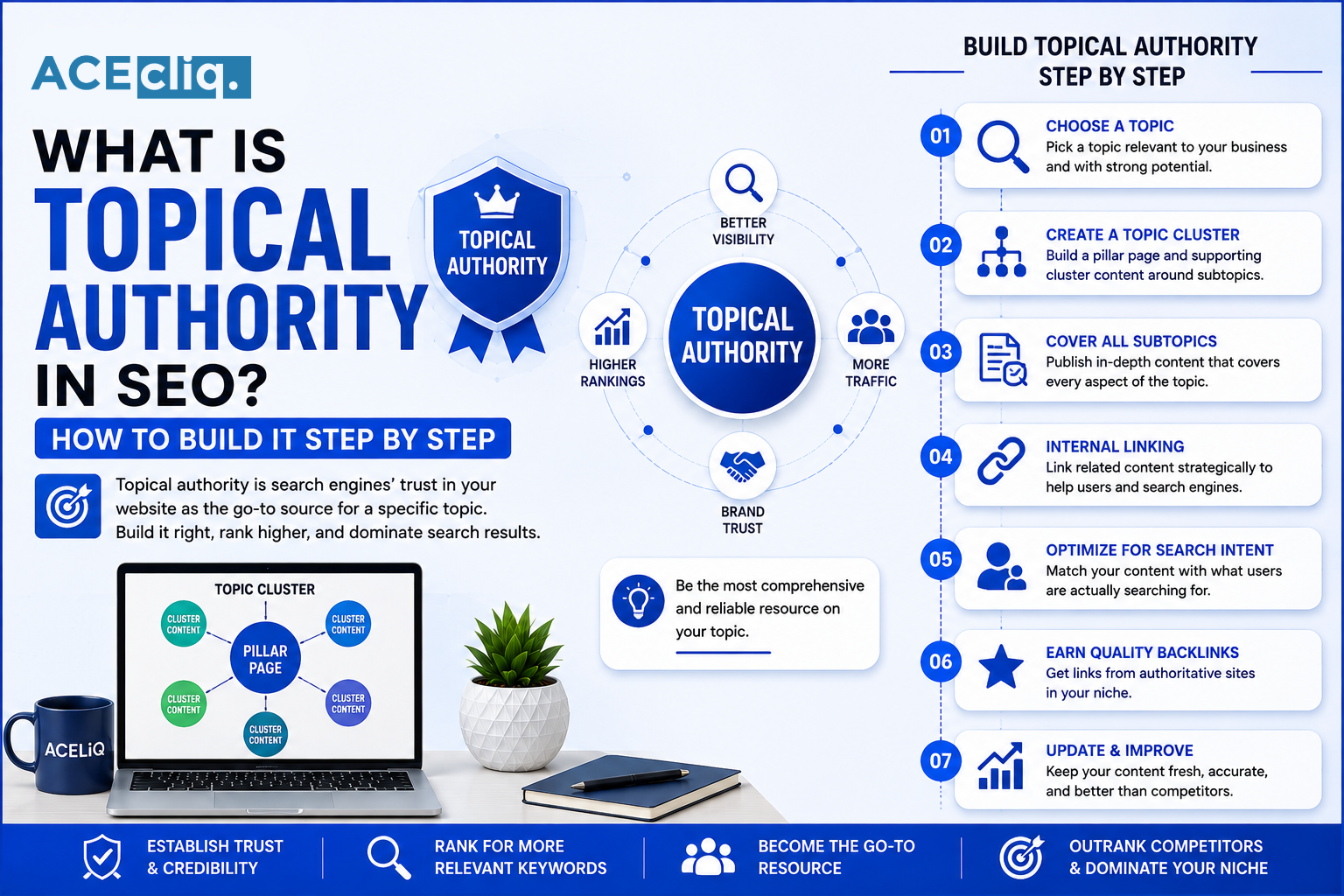
A Topic Cluster is a content structure where one central page covers a broad subject while several supporting pages address specific subtopics.
For example:
Pillar Topic: SEO
Supporting topics could include:
- Technical SEO
- On-Page SEO
- Local SEO
- Keyword Research
- SEO Audits
- Link Building
- Content SEO
- SEO KPIs
- Core Web Vitals
The pillar page provides an overview, while supporting articles explore individual subjects in greater depth.
Relevant internal links connect these pages, creating a structured content network.
This approach helps users discover related information and gives search engines clearer contextual relationships between pages.
How to Build Topical Authority Step by Step
Building topical authority requires planning rather than simply increasing publishing frequency.
Step 1: Choose Your Core Topic
Start with a subject closely connected to your business expertise.
For ACECLiQ, relevant core subjects could include SEO, digital marketing, PPC, content marketing, social media marketing, and AI search optimization.
The topic should have enough depth to support multiple related subtopics.
Avoid choosing subjects simply because they have high search volume. Your website should be able to demonstrate genuine expertise in the area.
Step 2: Research Related Subtopics
Once you have selected your core topic, identify the questions and subtopics users expect to find.
Research related searches, competitor content, customer questions, industry terminology, and different stages of the buying journey.
For example, an SEO content cluster might include beginner guides, technical explanations, strategy articles, comparison content, measurement guides, and practical tutorials.
This creates a comprehensive SEO Content Strategy rather than a collection of unrelated blog posts.
Step 3: Create a Strong Pillar Page
A pillar page provides a broad and useful overview of the main topic.
It should explain the fundamentals while linking readers to more detailed supporting resources.
A good pillar page should be comprehensive but should not attempt to explain every subtopic in extreme detail.
Its purpose is to organize the subject and guide users toward deeper content.
Step 4: Develop Supporting Content
Supporting articles target specific questions and subtopics related to your main subject.
For example, if your pillar page focuses on SEO, a supporting article could explain how to perform an SEO audit, while another discusses Core Web Vitals.
Each article should provide unique value rather than rewriting information already published elsewhere on the website.
This is where Content Clusters become particularly useful.
Step 5: Match Content With Search Intent
Every page should satisfy the reason behind the search.
A user searching "what is SEO" probably needs an educational explanation.
Someone searching "SEO agency" may be evaluating service providers.
Someone searching "SEO pricing" is likely researching costs before making a decision.
Understanding Search Intent ensures that each page provides the appropriate information instead of forcing every keyword into the same content format.
Build a Strong Internal Linking Structure
Internal linking is an important part of a topical website.
When related pages link to one another using relevant and descriptive anchor text, users can easily move through your content ecosystem.
For example, an article about Semantic SEO could naturally link to resources about Entity SEO, search intent, topic clusters, and content optimization.
Similarly, your SEO audit article could link to Core Web Vitals, technical SEO, and SEO KPIs.
These relationships create a logical information architecture and help distribute internal authority throughout your website.
Improve Content Quality and Expertise
Publishing more content does not automatically create authority.
Every article should provide genuine value and demonstrate appropriate expertise.
Strong content should be:
- Accurate
- Original
- Well researched
- Easy to understand
- Relevant to the audience
- Updated when necessary
- Supported by practical examples
Businesses should also demonstrate who is responsible for their content where appropriate.
Author information, company expertise, case studies, original insights, and transparent business information can contribute to a stronger overall trust experience.
Use Semantic SEO to Strengthen Topic Coverage
Semantic SEO complements topical authority by helping content cover related concepts and relationships naturally.
Suppose you are writing about Local SEO. Relevant concepts may include Google Business Profile, Google Maps, customer reviews, citations, location pages, local keywords, NAP consistency, and local backlinks.
These concepts should be included because they genuinely explain the subject—not because you need to hit a predetermined keyword count. The goal is comprehensive and natural coverage.
Measure Your Topical Authority
Topical authority is not represented by one universal Google metric.
Instead, businesses can monitor several indicators to understand whether their content strategy is gaining traction. Look at organic impressions, rankings across related queries, organic traffic, internal-link engagement, conversions, and the number of relevant keywords generating visibility. You can also review whether older supporting articles are beginning to rank for related searches beyond their original target keyword.
An increase in relevant search visibility across an entire topic can indicate that your website is developing stronger topical relevance.
Common Topical Authority Mistakes
One of the biggest mistakes is publishing large numbers of low-quality articles simply to create the appearance of topical depth.
More content does not necessarily mean more authority.
Another common problem is creating several articles targeting nearly identical search intent. This can make the website unnecessarily repetitive.
Businesses should also avoid excessive keyword stuffing, irrelevant topics, weak internal linking, outdated information, and AI-generated content that has not been reviewed for accuracy and usefulness. Topical authority should be built through quality, relevance, depth, and consistency.
A Practical Topical Authority Strategy for Businesses
Businesses can start by selecting three to five core topics closely related to their products or services.
For each topic, create one strong pillar resource and identify several supporting subjects.
Then organize the content into logical clusters and connect related pages through internal links.
Over time, update important articles, identify content gaps, and create new resources based on changing customer questions and search behavior.
This approach creates a scalable Content Strategy that can grow alongside the business.
Final Conclusion
Understanding What Is Topical Authority in SEO? is important for businesses that want to build sustainable organic visibility rather than chase individual keywords.
A strong topical strategy connects pillar pages, supporting content, related entities, search intent, and internal links into one organized content ecosystem. The objective is simple: become genuinely useful and knowledgeable about the topics that matter to your audience. When businesses consistently create high-quality content around their core areas of expertise, they can build stronger topical relevance, improve organic visibility, support better user experiences, and create a website that is easier for both users and search engines to understand.
At ACECLiQ, we help businesses develop strategic Topical SEO, content clusters, semantic content strategies, and internal linking structures designed to strengthen search visibility and support sustainable organic growth.