
Semantic SEO: How to Optimize Content for Topics, Entities, and Search Intent
Search engine optimization has moved far beyond simply placing a target keyword in a title, heading, and paragraph. Modern search engines are designed to understand language, context, relationships, and the purpose behind a user's query. This means businesses need to create content that answers the broader topic rather than optimizing every page around one isolated phrase.
Semantic SEO provides a more complete approach to content optimization by connecting keywords with related concepts, entities, questions, and user needs. Instead of asking, "How many times should I use my keyword?", marketers should ask, "Does this page completely answer what the user wants to know?"
For businesses, this shift creates an opportunity to build stronger Topical Authority, improve content relevance, and create resources that work for both traditional search and emerging AI-powered search experiences.
At ACECLiQ, we use topic-focused content strategies, entity optimization, internal linking, and search-intent analysis to create content that provides genuine value while strengthening a website's overall SEO foundation.
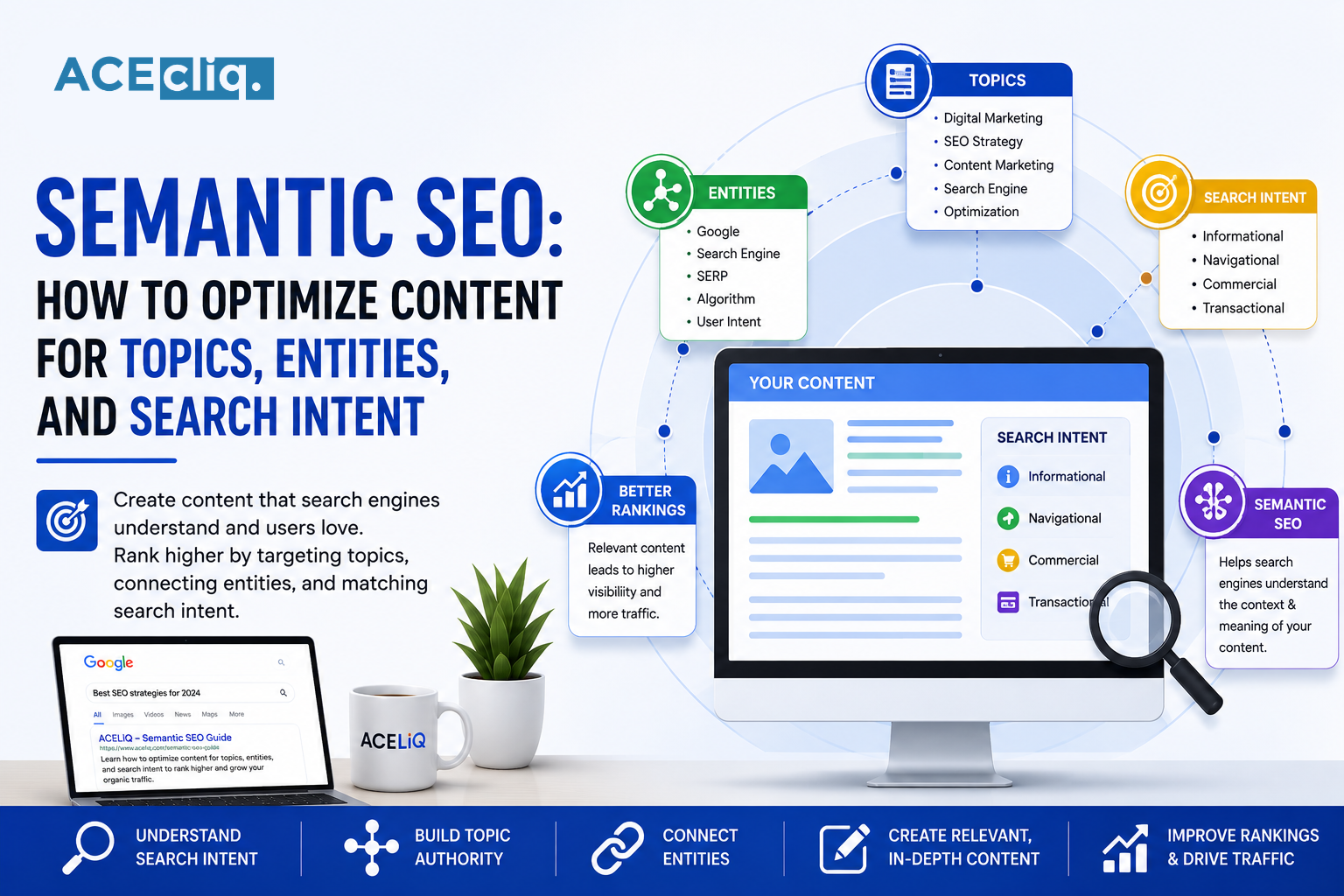
AI Overview
Semantic SEO is the process of creating and organizing content around topics, entities, relationships, and user intent rather than relying only on exact-match keywords. It helps search engines understand the meaning and context of content so they can better match webpages with relevant queries. A strong Semantic SEO Strategy combines comprehensive topic coverage, Entity-Based SEO, related concepts, internal linking, structured content, and Search Intent Optimization to build topical authority and improve organic visibility.
What Is Semantic SEO?
Semantic SEO is an approach to search optimization that focuses on the meaning, context, relationships, and concepts surrounding a topic.
Traditional keyword optimization may focus heavily on a phrase such as "digital marketing agency." A semantic approach goes further by covering concepts naturally associated with that subject, such as SEO, PPC, social media marketing, content marketing, lead generation, conversion optimization, analytics, and marketing strategy.
The purpose is not to insert every related term into an article.
Instead, these concepts should appear because they genuinely help explain the subject and satisfy the user's needs.
This creates Semantic Content Optimization, where content is developed around a complete subject rather than a single keyword.
How Semantic Search Works
Semantic Search allows search engines to interpret the meaning behind a query instead of relying exclusively on exact words.
Consider a user searching for:
"How can I make my website appear higher on Google?"
They may not use the phrase "SEO strategy," but their underlying intent is clearly related to search engine optimization.
A modern search engine can connect the user's wording with concepts such as rankings, technical SEO, content, backlinks, search intent, and website authority.
This is why writing naturally and covering important concepts within a subject is more useful than repeatedly inserting an exact keyword.
Why Semantic SEO Matters for Modern Websites
Search results are increasingly competitive. Publishing an article that contains a keyword is no longer enough to establish expertise.
Businesses need to demonstrate that their content provides comprehensive answers and understands the subject from multiple relevant perspectives.
A strong Semantic SEO Strategy can help businesses:
- Improve topical relevance
- Build subject authority
- Cover multiple related queries
- Match different search intents
- Strengthen internal linking
- Improve content depth
- Support AI search visibility
The objective is to create content that is genuinely useful rather than content designed only to manipulate rankings.
Keywords vs. Topics and Entities
Keywords remain important, but they are only one component of modern SEO.
A keyword is generally a word or phrase used in a search query. A topic represents the broader subject being discussed. An entity represents a clearly identifiable person, organization, place, product, or concept.
For example, consider the keyword "Apple."
Depending on the context, Apple could refer to a fruit or Apple Inc. The surrounding concepts help establish the intended meaning.
If an article discusses iPhones, MacBooks, iOS, Tim Cook, and Apple products, the context makes the business entity much clearer.
This demonstrates why Entity SEO and semantic optimization work together. Search engines can use relationships between concepts to better understand what content represents.
Understanding Search Intent
One of the most important parts of modern content optimization is understanding Search Intent.
Search intent describes what the user is actually trying to accomplish when entering a query.
Generally, search intent can be divided into several categories.
Informational Intent
The user wants to learn something.
Examples include:
- What is technical SEO?
- How does Google Search work?
- What is Semantic SEO?
Educational articles and comprehensive guides are generally suitable for informational searches.
Commercial Investigation
The user is researching options before making a decision.
Examples include:
- Best SEO agency for small businesses
- SEO tools comparison
- Google Ads vs SEO
Comparison pages, case studies, reviews, and detailed guides can satisfy this intent.
Transactional Intent
The user is ready to take an action.
Examples include:
- SEO services
- Hire SEO agency
- Buy SEO software
Service and product pages are generally better suited to transactional searches.
Navigational Intent
The user is looking for a specific website, brand, or destination.
Understanding these differences is essential for Search Intent Optimization. A page should be designed around what the searcher actually needs rather than forcing every query into the same content format.
How to Optimize Content for Topics
Topic optimization begins before writing the first paragraph.
Start by identifying the main subject and then map the important subtopics that a user would reasonably expect to find.
For example, an article about local SEO could naturally cover Google Business Profile, local keywords, reviews, citations, location pages, Google Maps, local backlinks, and NAP consistency.
This doesn't mean every article needs to cover everything imaginable.
The goal is to identify the concepts that are genuinely important to understanding the primary subject.
Research the Main Topic
Start with your primary subject and investigate the questions customers commonly ask.
Analyze search results, competitor content, People Also Ask questions, related searches, industry discussions, and your own customer queries.
This process reveals the language and concepts users associate with the topic.
Create a Content Outline Around User Needs
Once the important concepts are identified, organize them into a logical structure.
Use H2 and H3 headings to create clear topical sections. Each section should answer a specific question or explain an important part of the subject.
This makes the content easier for readers and search engines to understand.
How Entities Improve Content Relevance
Entities provide context that helps search engines distinguish between different meanings and establish relationships.
For example, an article about digital marketing could naturally mention organizations, platforms, tools, technologies, services, locations, and professionals relevant to the topic.
However, entities should never be added simply for SEO purposes.
Every entity should have a genuine relationship with the subject being discussed.
This is where Entity-Based SEO becomes valuable. Instead of viewing a webpage as a collection of keywords, businesses can build content around meaningful relationships between their brand, services, people, products, locations, and industry topics.
Build Topic Clusters and Topical Authority
A single blog post rarely establishes complete authority over a competitive subject.
This is why Topic Clusters are useful.
A topic cluster usually contains a central pillar page supported by several related articles.
For example, a digital marketing website could create a central page around digital marketing and support it with content about:
- SEO
- PPC
- Content Marketing
- Social Media Marketing
- Email Marketing
- Local SEO
- Analytics
- Conversion Optimization
Each supporting article can link back to the main topic while also connecting to other highly relevant resources.
Over time, this structure helps create Topical Authority and gives users a clear path to explore related information.
Use Related Keywords Naturally
Related keywords can help communicate context, but they should never be treated as a checklist.
For example, an article about Semantic SEO might naturally use phrases such as Semantic Search, Search Intent Optimization, Topic Clusters, Entity SEO, Topical Authority, content relevance, and contextual SEO.
These terms should appear where they make sense.
Avoid repeating variations of the same phrase in every paragraph. Modern content should prioritize clarity and usefulness over keyword density.
The best Related Keywords are those that naturally occur when an expert explains the subject thoroughly.
Are LSI Keywords Still Important?
The term LSI Keywords is commonly used in SEO discussions to describe words and phrases related to a primary topic.
However, marketers should avoid treating LSI as a secret list of keywords that automatically improves rankings.
Instead, focus on related concepts, terminology, entities, questions, and subtopics that make the content more complete. For example, an article about SEO audits would naturally discuss crawling, indexing, canonical tags, backlinks, technical SEO, internal links, Core Web Vitals, and content quality.
These concepts provide contextual depth without requiring artificial keyword insertion.
Strengthen Internal Linking
Internal linking is an important part of a semantic content architecture.
When related pages are connected through relevant anchor text, users can easily move between subjects while search engines can better understand relationships across your website.
For example, an article about Semantic SEO could naturally link to content about Entity SEO, SEO Audits, Topical Authority, and AI Search Optimization.
This creates a connected information ecosystem rather than a collection of isolated blog posts.
Your most important pages should receive relevant internal links from supporting content, while links should always make sense from the reader's perspective.
Optimize Content for AI Search
Search is increasingly becoming conversational, and AI-powered systems are changing how users discover information.
This makes contextual content particularly valuable.
AI systems need to understand:
- What a business does
- What a webpage discusses
- Who created the information
- Which entities are being referenced
- How concepts relate to each other
Creating clearly structured, authoritative, and context-rich content can help establish these relationships.
AI Search Optimization should not mean writing content exclusively for machines. The best approach is to create genuinely useful content that is easy for both humans and search systems to understand.
Common Semantic SEO Mistakes
One of the biggest mistakes is trying to include every possible related keyword.
This often produces unnatural content that is difficult to read.
Another mistake is creating dozens of articles that cover almost exactly the same subject with slightly different keywords. This can create unnecessary duplication instead of genuine topical depth.
Businesses should also avoid publishing AI-generated content without expert review, creating irrelevant entity associations, ignoring search intent, and building internal links purely for SEO manipulation.
Effective semantic optimization is based on relevance, accuracy, expertise, and useful relationships between content.
A Practical Semantic SEO Workflow
A successful Content Optimization process can be broken into several stages.
Start by identifying the main topic and understanding the audience's search intent. Research the important questions, related concepts, entities, and subtopics associated with that subject.
Next, create an outline that covers the topic comprehensively without unnecessary repetition. Use descriptive headings and organize information in a logical order.
After publishing, connect the article with relevant pages through internal links. Monitor rankings, impressions, clicks, engagement, and conversions to identify opportunities for improvement.
Finally, update important content when information, search behavior, or business offerings change.
This creates a continuous optimization cycle rather than treating SEO as a one-time activity.
How to Measure Semantic SEO Performance
Semantic optimization can be evaluated using both SEO and business metrics.
Look at whether your content is gaining visibility for a broader range of relevant queries rather than only one target keyword.
Monitor organic impressions, clicks, ranking distribution, engagement, conversions, and the number of pages receiving organic traffic.
You can also evaluate whether your content is attracting queries that were not explicitly targeted during the initial optimization process.
An increase in relevant query visibility can indicate that search engines are associating your content with a wider set of related concepts.
Ultimately, the most important measurement is whether the strategy attracts the right audience and contributes to meaningful business outcomes.
Semantic SEO vs Traditional Keyword SEO
Traditional keyword SEO often starts with a target phrase and optimizes a page around it. A semantic approach starts with the broader subject and asks what information users need to understand that subject completely. This doesn't make keywords irrelevant.
Instead, keywords become part of a larger framework that includes topics, entities, relationships, intent, content quality, and user experience. The strongest SEO strategies combine keyword research with semantic understanding rather than choosing one approach over the other.
Future of Semantic Search
Search engines are becoming increasingly capable of understanding natural language and relationships between concepts.
At the same time, users are moving toward conversational queries, AI-generated answers, voice search, and more complex research journeys.
This means websites need to become clearer about their identity and expertise.
Businesses should focus on creating interconnected content that demonstrates genuine knowledge, answers real questions, and provides useful context.
A website with strong Topical Authority, clear entities, relevant internal links, and comprehensive content is better positioned for the changing search landscape.
Final Conclusion
Semantic SEO represents a shift from optimizing webpages around isolated keywords toward building content that communicates meaning, context, relationships, and intent.
Businesses should think beyond exact-match phrases and focus on the complete information users need. This means understanding Search Intent, covering relevant topics, connecting related entities, developing Topic Clusters, strengthening internal links, and building genuine Topical Authority.
The goal is not to write content for algorithms.
The goal is to create the clearest and most useful resource for the person searching.
At ACECLiQ, we combine semantic content planning, entity optimization, technical SEO, internal linking, and search-intent analysis to help businesses build stronger organic visibility and future-ready digital marketing strategies.