
SEO KPIs Every Business Should Track in 2026 | ACECLiQ
Search engine optimization has become increasingly data-driven, making it essential for businesses to measure performance beyond keyword rankings alone. Many companies invest significant time and resources into SEO but struggle to determine whether their efforts are delivering real business results. Tracking the right Key Performance Indicators (KPIs) helps businesses understand what is working, identify opportunities for improvement, and make informed decisions that support long-term growth. By focusing on meaningful SEO metrics instead of vanity numbers, organizations can improve search visibility, generate qualified leads, and maximize their return on investment.
AI Overview
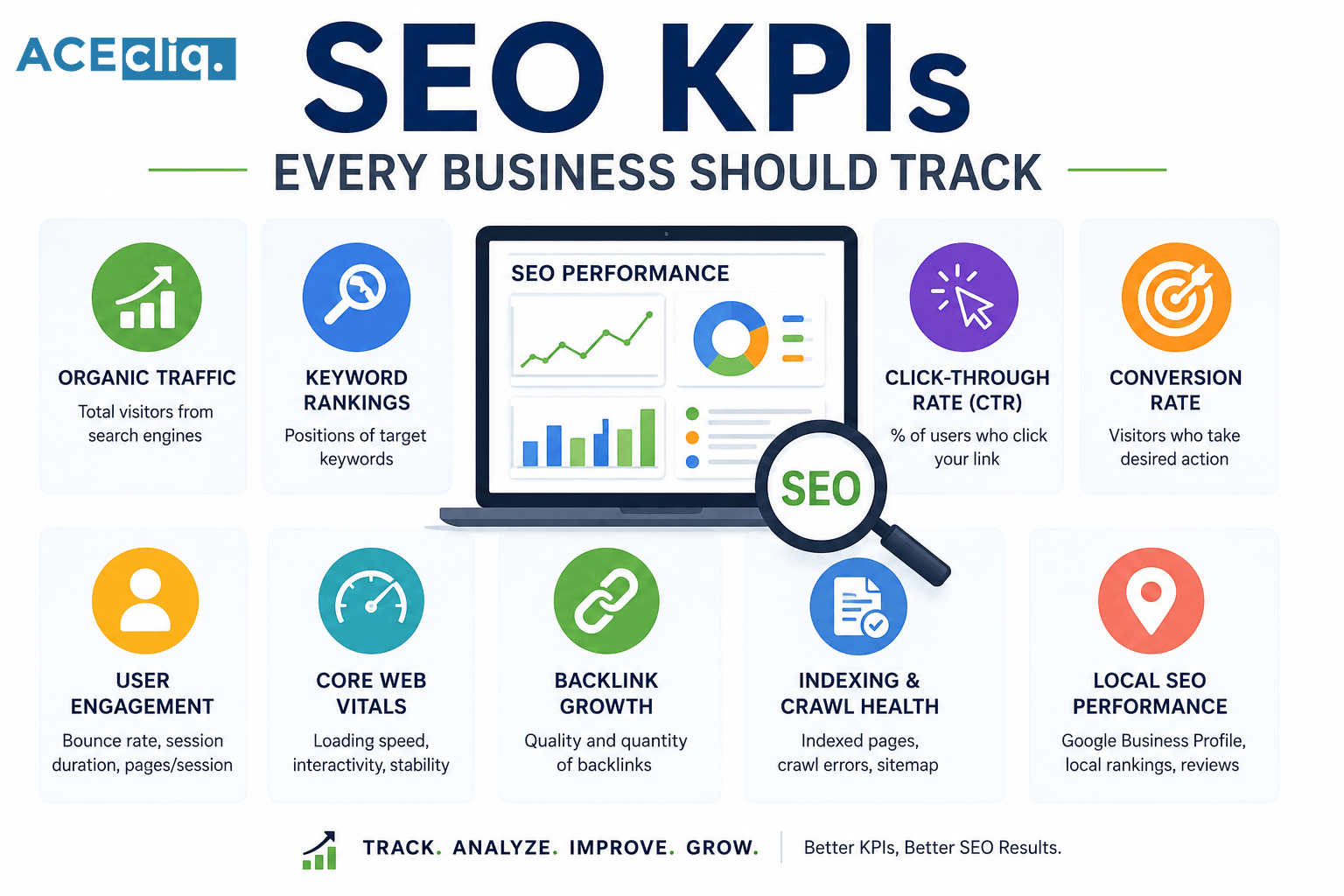
Measuring SEO success requires more than tracking keyword rankings. SEO KPIs Every Business Should Track explains the most important performance indicators that help businesses evaluate the effectiveness of their SEO strategy. From organic traffic and conversions to keyword visibility, Core Web Vitals, backlink growth, and user engagement, monitoring the right SEO KPIs enables businesses to make data-driven decisions, improve search performance, and maximize return on investment.
1. Organic Traffic
One of the most important SEO KPIs is Organic Traffic, as it reflects the number of visitors who reach your website through unpaid search engine results. A consistent increase in organic traffic generally indicates that your SEO strategy is improving your online visibility. However, traffic alone should not be the primary goal. Businesses should focus on attracting visitors who are genuinely interested in their products or services and are more likely to convert into customers. Monitoring traffic trends also helps identify which pages are performing well and which require further optimization.
2. Keyword Rankings
Tracking keyword rankings remains an important part of measuring SEO success because it shows how visible your website is for relevant search queries. Instead of monitoring hundreds of keywords, businesses should prioritize high-intent keywords that align with their services and target audience. Keyword rankings should always be analyzed alongside traffic and conversions, as achieving a top position is valuable only if it contributes to meaningful business outcomes. Regular monitoring also helps identify new opportunities to expand content and strengthen topical authority.
3. Click-Through Rate (CTR)
Your website may rank on the first page of Google, but if users are not clicking your listing, valuable traffic is being lost. Click-Through Rate (CTR) measures how often users click your website after seeing it in search results. Improving title tags, meta descriptions, structured data, and rich snippets can significantly increase CTR without changing rankings. A higher click-through rate indicates that your search listing is relevant, compelling, and aligned with user intent, making it one of the most valuable indicators of SEO performance.
4. Conversion Rate
Generating traffic is only the beginning of a successful SEO strategy. The real objective is to convert visitors into customers, inquiries, or leads. Conversion Rate measures how effectively your website encourages users to take meaningful actions, such as submitting a contact form, requesting a consultation, making a purchase, or subscribing to a newsletter. Tracking conversions helps businesses evaluate the actual business impact of their SEO efforts rather than simply measuring visitor numbers. A website that attracts fewer but highly qualified visitors often performs better than one generating large amounts of untargeted traffic.
5. User Engagement Metrics
Google increasingly rewards websites that provide excellent user experiences. Metrics such as engagement time, pages viewed per session, and bounce rate offer valuable insights into how visitors interact with your website. When users spend more time reading your content and exploring additional pages, search engines interpret these signals as indicators of quality and relevance. Improving website navigation, content readability, page structure, and overall usability can significantly enhance engagement, leading to stronger SEO performance over time.
6. Core Web Vitals
Website performance has become an essential ranking factor, making Core Web Vitals one of the most important SEO KPIs to monitor. These metrics evaluate loading speed, responsiveness, and visual stability to determine whether users have a smooth browsing experience. A fast-loading website not only improves rankings but also reduces bounce rates and increases user satisfaction. Businesses should regularly monitor these performance indicators and resolve issues related to slow loading times, unoptimized images, excessive scripts, or unstable layouts to maintain strong search visibility.
7. Backlink Profile
Backlinks continue to play a major role in Google's ranking algorithm because they demonstrate authority and trustworthiness. Rather than focusing on the total number of backlinks, businesses should monitor the quality of referring domains, anchor text diversity, and the acquisition of new authoritative links. A healthy backlink profile strengthens domain authority and supports higher rankings, while identifying and removing low-quality or toxic links helps protect long-term SEO performance.
8. Indexing and Crawl Health
A technically optimized website is essential for successful SEO. Businesses should regularly monitor whether important pages are being indexed correctly and whether search engine crawlers can access all valuable content. Issues such as crawl errors, broken links, duplicate pages, incorrect canonical tags, or outdated XML sitemaps can prevent pages from appearing in search results. Maintaining strong crawl health ensures that search engines can efficiently understand and rank your website.
9. Local SEO Performance
For businesses targeting customers within specific geographic areas, Local SEO metrics are equally important. Monitoring Google Business Profile views, Google Maps rankings, customer reviews, phone calls, direction requests, and local keyword rankings provides valuable insights into local search visibility. As location-based searches continue to grow, tracking these KPIs helps businesses understand how effectively they are reaching nearby customers and competing within their local market.
10. Measuring SEO ROI
Ultimately, every SEO campaign should contribute to measurable business growth. Businesses should evaluate SEO Return on Investment (ROI) by connecting organic traffic with revenue, lead generation, customer acquisition costs, and conversion values. Rather than focusing solely on rankings or traffic, organizations should analyze how SEO contributes to overall business objectives. Measuring ROI provides a clear understanding of whether optimization efforts are generating sustainable financial returns and helps guide future marketing investments.
Final Conclusion
Understanding SEO KPIs Every Business Should Track in 2026 enables businesses to measure the true impact of their SEO strategy and make data-driven decisions that support long-term success. While rankings remain important, they represent only one part of a much larger picture. By consistently monitoring organic traffic, keyword performance, click-through rates, user engagement, Core Web Vitals, backlink quality, local SEO metrics, and overall return on investment, businesses can build a more effective and sustainable search strategy. At ACECLiQ, we help businesses implement comprehensive SEO reporting and performance analysis that transforms raw data into actionable insights, ensuring every optimization effort contributes to higher rankings, qualified leads, and measurable business growth.