
How to Perform a Complete SEO Audit in 2026 | ACECLiQ
Search engine optimization is not a one-time task. Search algorithms continue to evolve, competitors constantly update their websites, and user expectations change every year. Even websites that performed well a few months ago may experience ranking declines if they are not monitored regularly. This is why conducting a comprehensive SEO audit has become an essential part of every successful digital marketing strategy.
Understanding How to Perform a Complete SEO Audit in 2026 enables businesses to identify technical issues, content gaps, user experience problems, and optimization opportunities before they negatively impact search performance. A thorough Complete SEO Audit helps improve website health, increase organic visibility, and create a stronger foundation for long-term growth.
At ACECLiQ, we perform data-driven Website SEO Audits that uncover hidden issues affecting rankings and provide actionable recommendations that improve search performance and business results.
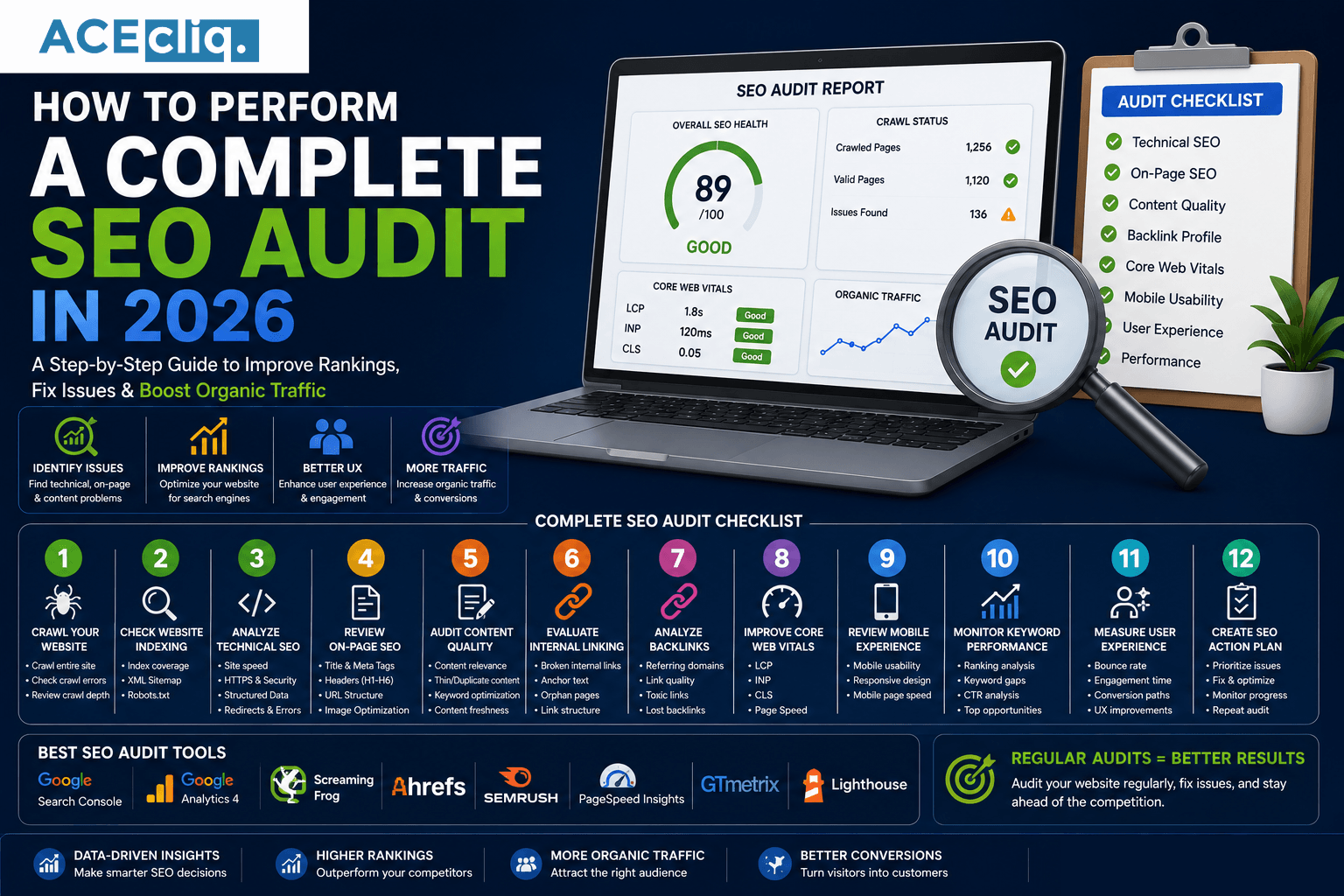
AI Overview
A comprehensive SEO audit helps businesses identify the strengths and weaknesses of their website before they affect search rankings and organic traffic. How to Perform a Complete SEO Audit in 2026 explains the essential steps required to evaluate technical SEO, on-page optimization, content quality, backlinks, Core Web Vitals, mobile usability, and user experience. By conducting regular SEO audits, businesses can fix hidden issues, improve website performance, increase search visibility, and build a stronger foundation for long-term digital growth.
What is an SEO Audit?
An SEO Audit is a detailed evaluation of your website's overall search engine performance. It examines every factor that influences your ability to rank on Google, including technical infrastructure, content quality, backlinks, website architecture, mobile usability, and user experience.
Rather than focusing on a single issue, an audit provides a complete picture of your website's SEO health.
Regular SEO Analysis allows businesses to detect problems early and continuously improve their digital presence.
Why SEO Audits Are Important
Many businesses invest heavily in content creation and link building but overlook the technical health of their websites.
Small issues such as broken links, slow loading pages, duplicate content, or incorrect indexing settings can significantly reduce organic visibility.
A comprehensive Website SEO Optimization process helps businesses:
- Improve crawlability
- Increase search visibility
- Fix technical errors
- Enhance user experience
- Strengthen website authority
- Increase organic traffic
Routine audits ensure your SEO strategy remains aligned with Google's latest ranking factors.
Step 1: Crawl Your Website
The first stage of every Complete SEO Audit is crawling the website.
Website crawlers identify technical issues that search engines may encounter while indexing your pages.
A crawl helps discover:
- Broken links
- Redirect errors
- Duplicate pages
- Missing metadata
- Crawl depth problems
- Orphan pages
Understanding how search engines view your website provides the foundation for every optimization effort.
Step 2: Check Website Indexing
A website cannot rank if important pages are not indexed.
Businesses should regularly review indexed pages to ensure search engines can discover valuable content while excluding unnecessary or duplicate pages.
Proper Technical SEO Audit includes checking:
- XML Sitemap
- Robots.txt
- Canonical tags
- Noindex directives
- Index coverage reports
Correct indexing improves crawl efficiency and search visibility.
Step 3: Analyze Technical SEO
Technical SEO forms the backbone of a healthy website.
Search engines evaluate technical signals before considering content quality.
A complete Technical SEO Audit should evaluate:
- HTTPS security
- Website architecture
- Structured data
- Crawl errors
- Redirect chains
- Duplicate URLs
- Server response times
Resolving technical issues improves website performance while making content easier for search engines to understand.
Step 4: Review On-Page SEO
Every page should be optimized for both users and search engines.
An effective On Page SEO Audit includes reviewing:
- Title tags
- Meta descriptions
- Header structure
- URL optimization
- Image alt text
- Keyword placement
- Internal links
On-page optimization improves content relevance while increasing click-through rates from search results.
Each page should clearly satisfy user intent rather than simply targeting keywords.
Step 5: Audit Content Quality
Content remains one of Google's strongest ranking signals.
Businesses should evaluate every important page to ensure it provides original, valuable, and comprehensive information.
A successful content audit examines:
- Content freshness
- Search intent alignment
- Readability
- Keyword relevance
- Duplicate content
- Thin pages
Updating outdated content often produces faster SEO improvements than publishing new articles alone.
High-quality content strengthens authority and supports better rankings.
Step 6: Evaluate Internal Linking
Internal links help search engines understand relationships between pages while guiding visitors toward valuable resources.
A strong internal linking strategy distributes authority throughout the website and improves crawl efficiency.
Businesses should ensure every important page connects naturally with related blogs, service pages, and supporting content.
Well-planned internal links also increase user engagement and reduce bounce rates.
Step 7: Analyze Your Backlink Profile
Backlinks continue to influence Google's ranking algorithms.
However, quality matters far more than quantity.
A SEO Performance Audit should evaluate:
- Referring domains
- Link quality
- Anchor text diversity
- Toxic backlinks
- Lost backlinks
Removing harmful links while acquiring authoritative backlinks strengthens domain authority and long-term search visibility.
Step 8: Improve Core Web Vitals
Google uses Core Web Vitals to evaluate user experience.
A fast, responsive website encourages visitors to stay longer while improving overall search performance.
Businesses should regularly optimize:
- Loading speed
- User interaction
- Visual stability
- Mobile performance
Improving website speed benefits both users and search engines.
Technical performance should always be part of every SEO Audit Checklist.
Step 9: Review Mobile User Experience
Most website visitors now browse using mobile devices.
Google primarily evaluates mobile versions of websites through mobile-first indexing.
Businesses should verify:
- Responsive design
- Mobile page speed
- Readable typography
- Touch-friendly navigation
- Easy-to-use forms
Excellent mobile experiences contribute directly to stronger rankings and higher conversions.
Step 10: Monitor Keyword Performance
Understanding keyword performance helps businesses measure SEO success.
Review:
- Ranking improvements
- Keyword opportunities
- Search intent
- Organic click-through rates
- Landing page performance
Monitoring keyword trends helps identify which pages deserve additional optimization.
Keyword tracking also reveals emerging opportunities before competitors discover them.
Step 11: Analyze User Experience Signals
SEO extends beyond technical optimization.
Search engines increasingly reward websites that provide positive user experiences.
Businesses should evaluate:
- Bounce rate
- Average engagement time
- Navigation
- Content readability
- Conversion paths
Improving user experience often leads to stronger rankings and higher conversion rates.
Step 12: Create an SEO Action Plan
An SEO Audit becomes valuable only when its findings are implemented.
Businesses should prioritize issues based on their potential impact.
Typical priorities include:
- Critical technical fixes
- Content optimization
- Internal linking improvements
- Page speed optimization
- Backlink acquisition
- User experience enhancements
A structured action plan ensures continuous SEO improvements rather than isolated changes.
Common SEO Audit Mistakes
Many businesses perform audits but overlook important areas.
Common mistakes include:
- Auditing only technical SEO
- Ignoring search intent
- Forgetting mobile optimization
- Overlooking Core Web Vitals
- Neglecting internal linking
- Failing to update existing content
- Ignoring backlink quality
A successful SEO Audit Guide evaluates every aspect of website performance rather than focusing on individual metrics.
Final Conclusion
Understanding How to Perform a Complete SEO Audit in 2026 is essential for businesses that want to improve search rankings, increase organic traffic, and maintain long-term online visibility.
A comprehensive Complete SEO Audit goes beyond identifying problems—it creates a roadmap for continuous improvement by evaluating technical SEO, on-page optimization, content quality, backlinks, Core Web Vitals, and user experience.
At ACECLiQ, we provide in-depth SEO Audit Services that uncover hidden opportunities, resolve technical issues, and develop customized optimization strategies designed to improve rankings, attract qualified visitors, and drive measurable business growth.