What Is Entity SEO? How Google Understands Brands, People & Businesses | ACECLiQ
Search Engine Optimization has changed significantly. In the early days of SEO, marketers could focus heavily on individual keywords and optimize a webpage around exact phrases. Modern search is much more sophisticated. Search engines increasingly try to understand the meaning, context, relationships, and entities behind a search query.
This is where Entity SEO becomes important.
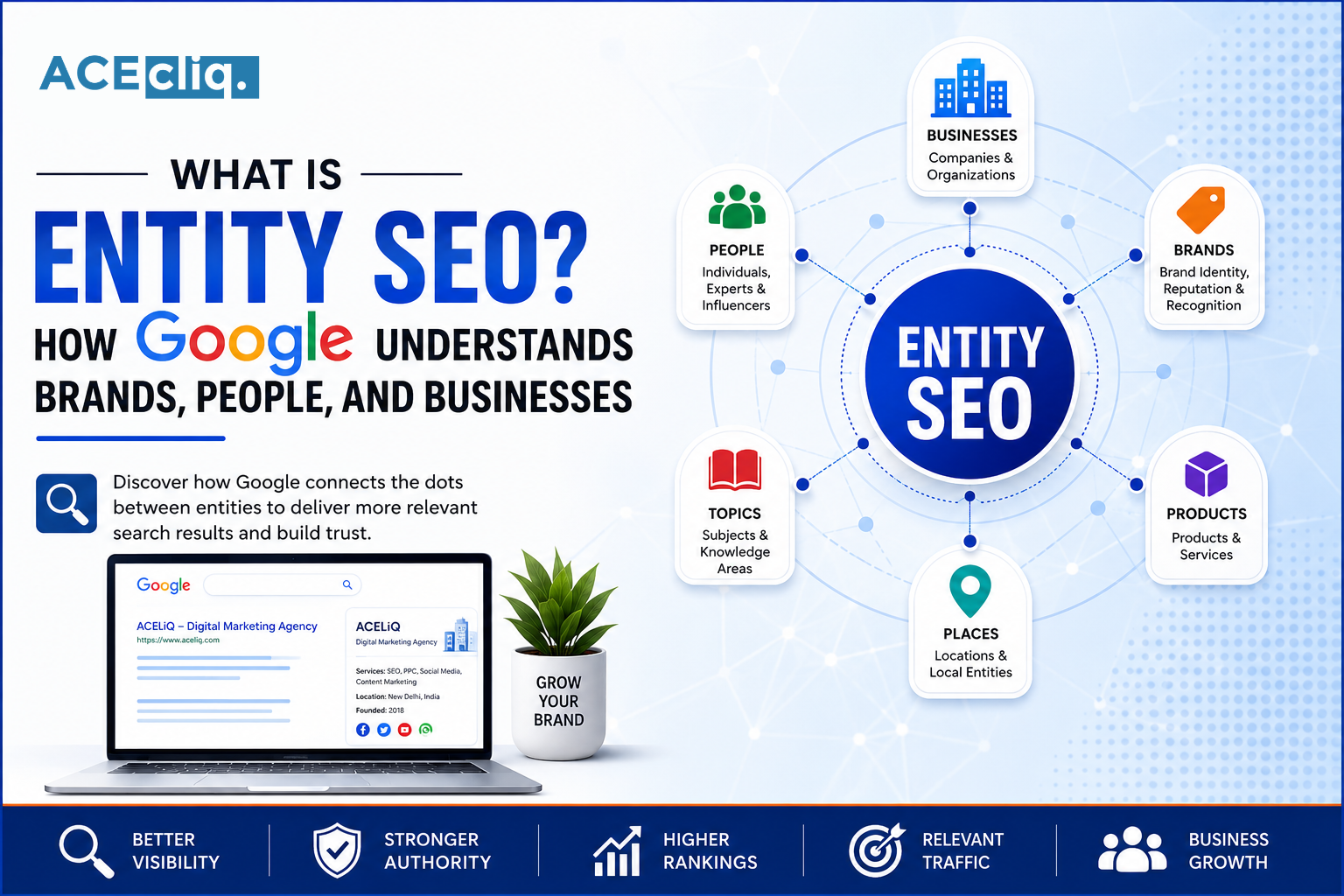
An entity can represent a clearly identifiable person, organization, brand, location, product, place, or concept. Google doesn't simply need to know that a webpage contains the words "digital marketing agency." It also needs to understand what the business is, what services it provides, where it operates, and how it relates to other concepts. For businesses competing in modern search, creating a recognizable and trustworthy digital entity can strengthen overall search visibility.
At ACECLiQ, we combine traditional SEO with Semantic SEO, structured content, topical authority, and entity-focused optimization to help businesses build stronger digital identities.
AI Overview
Entity SEO is an approach to search optimization that focuses on helping search engines understand who or what a website, brand, person, product, or organization represents and how it relates to other entities. Instead of relying only on individual keywords, Entity-Based SEO builds clear connections between topics, people, organizations, locations, products, and concepts. Google uses systems such as its Knowledge Graph and information from webpages, structured data, and other sources to understand entities and their relationships.
What Is Entity SEO?
Entity SEO is the practice of optimizing a website and its digital presence so search engines can better understand the entities represented by a business, person, brand, product, or organization and the relationships between them.
For example, imagine a company called ACECLiQ.
Google should ideally understand that ACECLiQ is a digital marketing agency, what services it offers, which locations it serves, what topics it specializes in, and how its website connects those services with relevant content. This is different from simply repeating the phrase "digital marketing agency" throughout a website.
The goal is to establish meaning and context, not keyword repetition.
Why Google Thinks Beyond Keywords
Search engines need to understand what users actually mean when they search.
A single word can have multiple meanings, while different words can refer to the same concept.
For example, a user may search:
"best SEO company"
Another user might search:
"SEO agency for my business"
Although the wording is different, both searches may have a similar underlying intent.
Modern search systems use language understanding and relationships between concepts to interpret queries more effectively. This is why Semantic SEO, search intent, and topical relevance have become increasingly important.
Keywords vs Entities
Keywords and entities are not competing concepts. They work together.
Keywords describe the words users type into search engines, while entities represent the identifiable concepts behind those words.
For example, consider a page about Apple.
The word "Apple" could refer to:
- Apple Inc.
- Apple the fruit
- Apple Records
- A product or brand reference
Context helps search engines determine which meaning is relevant.
A strong Entity-Based SEO strategy therefore provides enough contextual information for search engines to understand exactly what a page and website represent.
How Google Understands a Brand as an Entity
A brand becomes easier for search engines to understand when information about it is consistent and connected across the web.
Important signals can include the company's official website, business information, branded searches, relevant third-party references, social profiles, structured data, and authoritative content.
For example, a digital marketing agency should clearly communicate:
- Its official brand name
- Core services
- Industry expertise
- Locations
- Relevant team members
- Business information
- Associated topics
The objective is to create a consistent brand entity rather than disconnected mentions of a company name.
How Google Understands People as Entities
People can also function as important search entities.
Authors, founders, executives, experts, creators, and industry professionals may develop recognizable digital identities through consistent information across relevant sources.
A strong Person Entity strategy can include an author's biography, professional experience, publications, organization affiliations, author pages, and relevant social profiles.
For content-heavy websites, clearly identifying who created or reviewed important information can also support transparency and credibility.
The goal is not to manufacture an entity but to accurately represent a real person and their expertise.
How Google Understands Businesses
Businesses are particularly important entities for local and commercial search.
A business website should clearly communicate what the organization does, where it operates, and how users can interact with it.
For example, a business may be associated with:
Brand → Organization → Services → Location → Website → People → Topics
These relationships provide useful context.
For local businesses, accurate business information and appropriate LocalBusiness Schema can further help search engines interpret information about the organization. Google recommends using structured data according to its supported guidelines and emphasizes that structured data should accurately represent visible page content.
What Is the Google Knowledge Graph?
The Google Knowledge Graph is Google's system for connecting information about real-world entities and their relationships.
It helps Google understand concepts such as people, organizations, places, products, and other topics. Google's own developer documentation demonstrates that Knowledge Graph entities can be associated with capabilities such as brands and creator topics.
This is important because search increasingly depends on understanding relationships rather than simply matching isolated keywords.
However, businesses should not assume that adding schema automatically creates a Knowledge Panel or guarantees a specific search result. Structured data can help Google understand content, but Google does not guarantee that search features will appear.
The Role of Semantic SEO
Semantic SEO focuses on meaning and relationships between concepts.
Suppose you publish an article about "SEO for ecommerce websites."
Instead of repeatedly using the same keyword, a semantically rich article might naturally cover:
Product pages, category pages, technical SEO, product schema, internal linking, search intent, ecommerce keywords, Google Shopping, organic traffic, and conversion optimization.
These related concepts help establish topical depth.
This is why modern content should be comprehensive without becoming repetitive or artificially stuffed with keywords.
How Schema Markup Supports Entity SEO
Schema Markup is structured data that helps communicate information about webpage content in a standardized format.
Depending on the page, businesses may use appropriate structured data types such as:
- Organization
- Person
- LocalBusiness
- Product
- Article
- WebSite
For example, an organization's structured data can communicate information such as its name, logo, contact details, and other relevant properties.
Google recommends following its structured-data guidelines and validating implementations before deployment.
The important point is that schema should describe information that genuinely exists on the page. It should not be used to create misleading associations.
How to Build Entity Authority
Entity authority develops through consistency, relevance, expertise, and corroboration.
Start by making your website's identity extremely clear. Your homepage, About page, service pages, contact information, author profiles, and business listings should communicate a consistent understanding of the organization.
Then build topical depth around your core areas of expertise.
For example, an SEO agency can create interconnected content around technical SEO, local SEO, content marketing, AI search, keyword research, SEO audits, and Google Business Profile optimization.
This creates a broader topical authority ecosystem instead of isolated blog posts.
Connect Related Entities Through Internal Linking
Internal linking is another practical way to establish relationships between concepts on your website.
Imagine ACECLiQ publishes an article about Technical SEO.
That article could naturally link to related resources about:
Core Web Vitals → SEO Audit → Website Performance → On-Page SEO → SEO KPIs
These connections help users navigate the website while creating a logical content structure.
A strong internal linking strategy can therefore support both topical authority and contextual understanding.
Entity SEO and AI Search
Entity optimization is becoming particularly relevant as search experiences become more conversational and AI-driven.
AI-powered search needs to understand not only what a webpage says but also what the information refers to.
A business that has a clear digital identity, consistent information, authoritative content, and strong topical relationships can provide AI systems with more useful context.
Google's current guidance also emphasizes that existing SEO fundamentals remain relevant for its generative AI search features. Google added dedicated guidance in 2026 explaining how websites can optimize for generative AI features while emphasizing established SEO best practices.
This means businesses should not treat AI Search Optimization as a replacement for SEO. Instead, entity understanding, quality content, technical accessibility, and traditional SEO should work together.
Common Entity SEO Mistakes
One common mistake is treating entity optimization as simply adding schema markup to every page.
Schema alone does not create authority.
Another problem is inconsistent business information. If your company name, address, services, or other important details vary substantially across important sources, establishing a clear digital identity becomes more difficult.
Businesses should also avoid creating artificial relationships between unrelated entities, publishing thin content purely to target keywords, or generating large amounts of low-value AI content.
Effective Entity Optimization is based on accuracy, consistency, relevance, and genuine expertise.
Entity SEO Checklist
Before considering your website optimized for entities, review whether your brand identity is clearly represented across your website. Your business should have a consistent name, clear About information, accurate contact details, well-defined services, and appropriate structured data. Your content should cover related topics comprehensively and connect them through meaningful internal links.
Authors should be clearly identified where appropriate, while business and location information should remain consistent across important platforms.
Finally, regularly review your website and structured data as your business changes. Google recommends monitoring structured-data implementations and using tools such as Search Console and URL Inspection to understand how Google processes your pages.
Final Conclusion
Entity SEO represents an important evolution in how businesses should think about search optimization. Instead of treating SEO as a collection of keywords, businesses need to establish clear identities, relationships, context, and topical relevance. Google increasingly needs to understand who you are, what your business does, what topics you specialize in, where you operate, and how your website connects these concepts.
That makes Entity-Based SEO, Semantic SEO, structured data, internal linking, topical authority, and consistent brand information valuable components of a modern SEO strategy. For businesses preparing for AI-powered search, the goal should not be to chase every new optimization acronym. Build a website that clearly represents the real business, provides genuinely useful information, demonstrates expertise, and makes relationships between important concepts easy to understand.
At ACECLiQ, we help businesses build this kind of search-ready digital presence through strategic SEO, technical optimization, content strategy, structured data, and topical authority development.