
10 Common SEO Mistakes That Are Killing Your Rankings | ACECLiQ
Search engine optimization is one of the most effective ways to generate long-term organic traffic and qualified leads. However, many businesses fail to achieve consistent results because they unknowingly make mistakes that prevent their websites from ranking higher on Google.
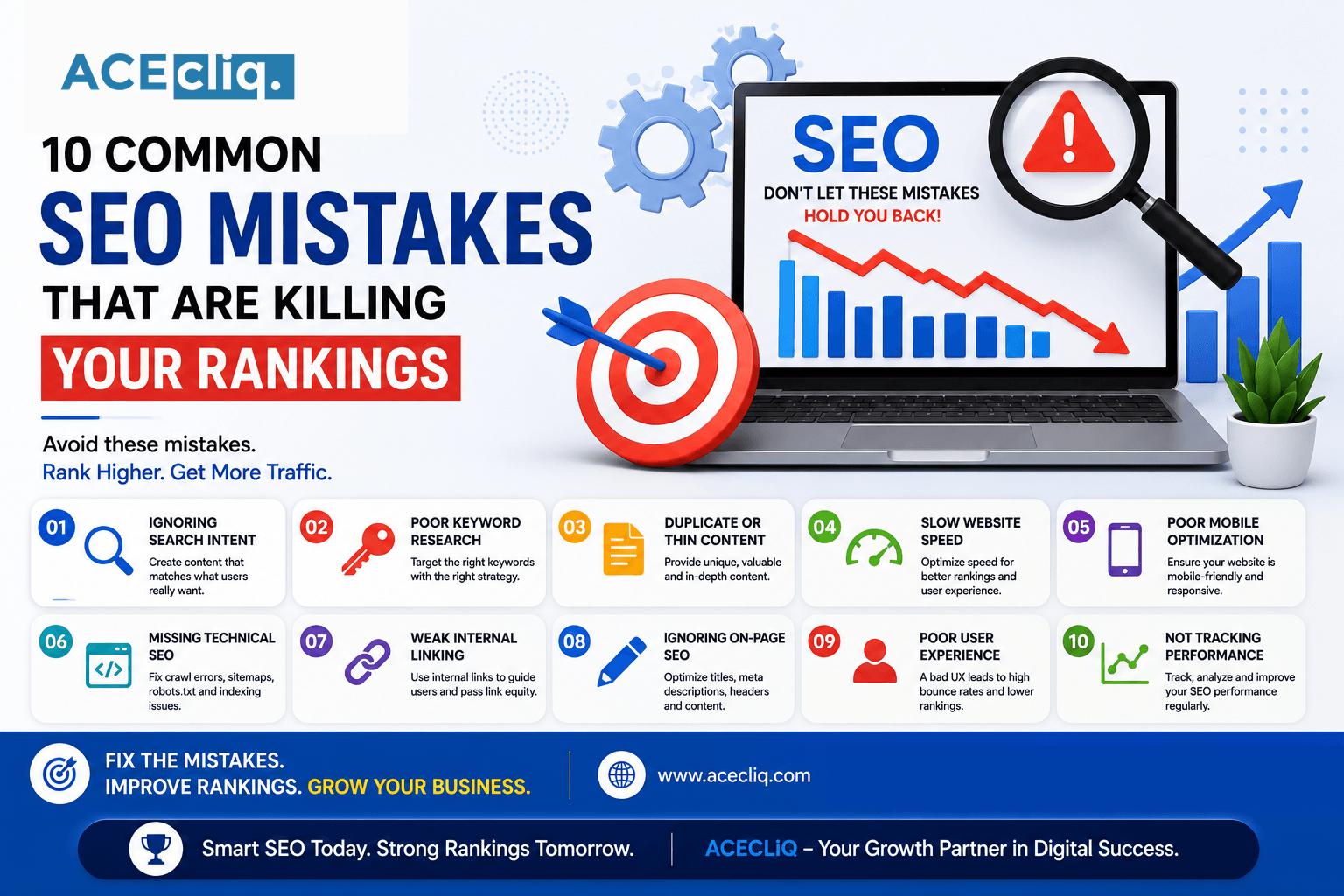
Understanding the 10 Common SEO Mistakes That Are Killing Your Rankings is essential for businesses looking to improve their online visibility. Search engines continue to evolve, and modern SEO requires more than simply adding keywords to a webpage. Factors such as user experience, technical optimization, content quality, and search intent now play a significant role in determining rankings.
At ACECLiQ, we regularly perform SEO audits for businesses and often find recurring issues that significantly impact search performance. Identifying and fixing these mistakes can dramatically improve organic traffic, keyword rankings, and lead generation.
AI Overview
Many businesses invest time and money into SEO but still struggle to achieve higher rankings because they unknowingly make critical optimization mistakes. Understanding the 10 Common SEO Mistakes That Are Killing Your Rankings can help businesses identify hidden issues affecting search visibility, user experience, and organic traffic. From poor keyword targeting and slow website speed to duplicate content and weak technical SEO, avoiding these mistakes is essential for long-term digital success. This guide explains the most common SEO errors and provides practical solutions to improve rankings and generate sustainable organic growth.
Why SEO Mistakes Matter
SEO is a long-term investment. Even a well-designed website can struggle to rank if it contains technical issues or poor optimization practices.
Search engines evaluate hundreds of ranking signals before displaying results. If your website fails to meet modern SEO standards, competitors with better optimization will likely outrank you.
By avoiding common SEO mistakes, businesses can improve crawlability, user engagement, and search visibility while building long-term authority.
1. Ignoring Search Intent
One of the biggest mistakes businesses make is focusing only on keywords instead of understanding why users are searching.
Google now prioritizes content that satisfies user intent. Simply inserting keywords throughout an article is no longer enough.
For example, someone searching "best CRM software" may want comparisons, reviews, or pricing—not just a product page.
Creating content that genuinely answers user questions improves rankings, engagement, and conversions.
Understanding search intent is one of today's most important SEO best practices.
2. Poor Keyword Research
Many websites target extremely competitive keywords while ignoring valuable long-tail opportunities.
Effective Keyword Research should identify phrases that:
- Match business goals
- Reflect user intent
- Have realistic competition
- Generate qualified traffic
Instead of targeting only broad terms, businesses should build topical authority around related keywords that attract highly relevant visitors.
A strong keyword strategy lays the foundation for successful website SEO optimization.
3. Publishing Thin or Duplicate Content
Content quality has become one of Google's strongest ranking factors.
Publishing short pages with little value or copying content from other websites can negatively impact rankings.
Each page should provide unique insights, solve specific problems, and answer user questions comprehensively.
High-quality SEO Content also demonstrates expertise, authority, and trustworthiness, helping websites build long-term credibility.
Avoiding duplicate content remains one of the simplest ways to improve Google ranking improvement.
4. Slow Website Speed
Website speed directly affects both user experience and search rankings.
Visitors expect pages to load within a few seconds. Slow websites often experience higher bounce rates and lower conversions.
Businesses should regularly optimize:
- Images
- JavaScript
- CSS files
- Browser caching
- Server response times
Improving page speed benefits both users and search engines, making it a critical part of any technical SEO strategy.
5. Poor Mobile Optimization
More than half of all web traffic now comes from mobile devices.
A website that performs poorly on smartphones can lose both rankings and potential customers.
Responsive design, readable text, fast loading times, and intuitive navigation are essential for delivering a positive mobile experience.
Mobile-first indexing means Google primarily evaluates the mobile version of your website when determining rankings.
6. Neglecting Technical SEO
Technical SEO issues often remain unnoticed because they are not visible to visitors.
However, search engines rely on technical optimization to crawl and index websites effectively.
Common technical problems include:
- Broken links
- Crawl errors
- Missing XML sitemaps
- Incorrect robots.txt configuration
- Indexing issues
Regular SEO audit checklists help businesses identify and fix these problems before they affect rankings.
7. Weak Internal Linking
Many businesses underestimate the importance of internal links.
Internal linking helps search engines understand website structure while guiding visitors toward relevant content.
A strong internal linking strategy distributes authority across important pages and improves user engagement.
Every major blog should naturally connect with related articles, service pages, and resources.
Internal links also encourage visitors to spend more time exploring your website.
8. Ignoring On-Page SEO
Even excellent content can struggle to rank without proper on-page optimization.
Every page should include:
- Optimized title tags
- Meta descriptions
- Header hierarchy
- Image alt text
- Descriptive URLs
- Relevant internal links
Good on-page SEO helps search engines understand your content while improving click-through rates from search results.
9. Poor User Experience
Google increasingly rewards websites that provide positive user experiences.
Factors such as confusing navigation, intrusive pop-ups, poor readability, and cluttered layouts can negatively impact engagement.
Businesses should focus on creating websites that are easy to navigate, visually appealing, and helpful to users.
Better Core Web Vitals in SEO & user experiences often result in longer session durations, lower bounce rates, and stronger search performance.
10. Not Measuring SEO Performance
Many businesses invest in SEO without tracking results.
Without analytics, it becomes impossible to identify what's working and what needs improvement.
Businesses should regularly monitor:
- Organic traffic
- Keyword rankings
- Click-through rates
- Bounce rates
- Conversion rates
- Technical health
Continuous analysis allows marketers to refine their SEO strategy 2026 and achieve better long-term outcomes.
Bonus Mistake: Ignoring Local SEO
For businesses serving specific geographic areas, local optimization is essential.
An incomplete Google Business Profile, inconsistent business information, or a lack of customer reviews can significantly reduce local visibility.
Local SEO helps businesses appear in location-based searches and attract nearby customers actively looking for their services.
At ACECLiQ, local SEO is one of the core strategies we use to help businesses generate high-quality leads from organic search.
How to Avoid These SEO Mistakes
Successful SEO requires ongoing optimization rather than one-time changes.
Businesses should regularly perform SEO audits, update content, improve website performance, and monitor search trends.
Combining high-quality content with strong technical foundations, excellent user experience, and strategic keyword targeting creates sustainable long-term growth.
SEO is not about finding shortcuts—it is about consistently providing value to both users and search engines.
Final Conclusion
Understanding the 10 Common SEO Mistakes That Are Killing Your Rankings can help businesses identify the hidden issues preventing them from reaching the top of search results.
By avoiding poor keyword strategies, improving technical SEO, creating valuable content, optimizing user experience, and continuously monitoring performance, businesses can significantly improve their search visibility and organic traffic.
At ACECLiQ, we specialize in identifying SEO issues, developing customized optimization strategies, and helping businesses achieve higher rankings through ethical, data-driven SEO practices. Whether you're launching a new website or improving an existing one, avoiding these common mistakes is the first step toward sustainable online success.