
SEO Content Pruning: When to Update, Merge, or Remove Old Content
A website can have excellent content and still struggle with SEO if its pages are poorly organized. When important resources are difficult to find, buried deep within the site, or disconnected from related content, both users and search engines can have trouble understanding the website.
This is why SEO-Friendly Website Architecture should be planned before a website grows too large.
A strong architecture creates logical relationships between pages, makes navigation easier, supports efficient crawling, and helps users quickly find the information they need.
For businesses, website architecture should connect SEO with usability. The goal is not to create a complicated technical structure but to build a website that is simple, logical, scalable, and easy to understand.
At ACECLiQ, we approach website architecture by combining technical SEO, content organization, internal linking, search intent, and user experience.
AI Overview
An SEO-friendly website architecture organizes webpages into a logical structure that makes it easy for users and search engines to navigate, discover, and understand important content. A strong structure typically includes clear categories, descriptive URLs, logical navigation, strategic internal linking, breadcrumbs, and a manageable page hierarchy. Businesses should organize related content into meaningful sections while avoiding unnecessary complexity and orphan pages. A well-planned website architecture supports crawlability, indexability, user experience, and a stronger overall SEO foundation.
What Is Website Architecture in SEO?
Website architecture refers to how the pages of a website are organized and connected.
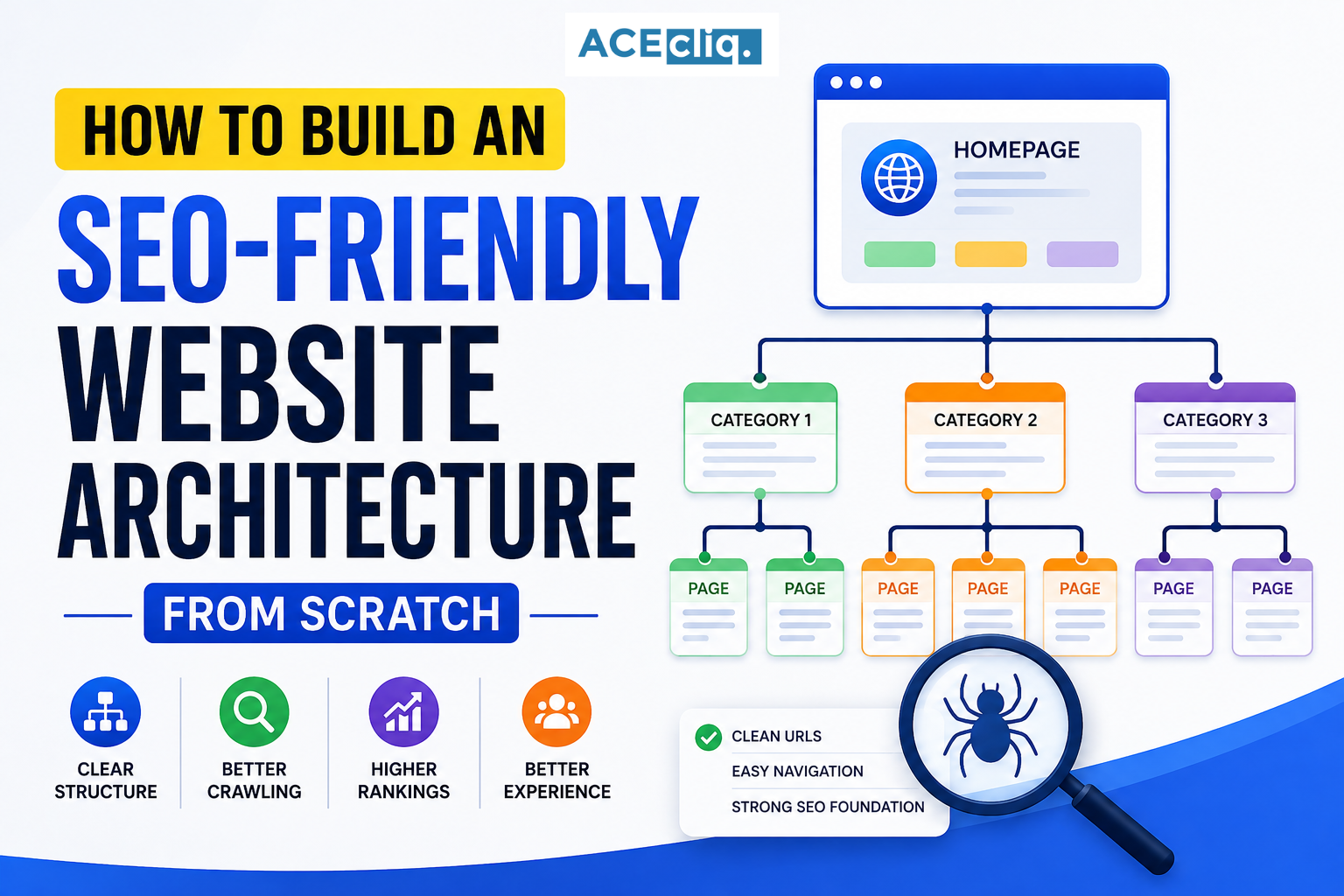
Think of your website as a building. The homepage is the main entrance, categories are different sections, and individual pages are the rooms.
A well-designed structure makes it easy to move from one section to another.
For SEO, this structure also helps search engines discover and understand relationships between pages.
A website should have a clear hierarchy where important pages are easily accessible and related content is logically connected.
Why Website Architecture Matters for SEO
Search engines need to crawl websites, discover URLs, understand content, and determine which pages are important.
A confusing structure can make this process unnecessarily difficult.
A well-organized SEO Website Structure can improve crawlability, support internal linking, reduce orphan pages, make navigation easier, and help distribute authority throughout the site.
It also provides a better foundation for future content.
If you plan your architecture correctly from the beginning, adding new blogs, services, products, or location pages becomes much easier.
Start With Your Main Website Categories
The first step is identifying the major sections of your website.
For a digital marketing agency, the primary categories might include SEO, PPC, Social Media Marketing, Content Marketing, Web Development, and related services.
Each category should represent a meaningful part of the business.
Avoid creating categories simply because you want to target additional keywords. Categories should help users understand what your business offers and make related content easier to find.
Create a Clear Website Hierarchy
Your website hierarchy should generally move from broad topics to more specific pages.
For example:
Homepage → Services → SEO Services → Local SEO
This creates a logical relationship between the pages.
Your most important commercial pages should not be buried several levels deep.
A shallow and logical structure makes it easier for visitors to navigate and allows important URLs to receive relevant internal links.
Use Simple and Descriptive URLs
Your URL Structure should help users understand what a page is about.
For example:
/seo-services/
is generally clearer than:
/page?id=8472
For larger websites, URLs can also communicate relationships between categories and content where appropriate.
Avoid unnecessarily long URLs, excessive parameters, random numbers, or complicated folder structures.
The best URL is generally short, descriptive, and relevant to the page.
Build Strong Internal Linking
Internal Linking is one of the most important components of website architecture.
Links between related pages help users discover additional information and help search engines understand how different resources relate to each other.
For example, an article about keyword research could naturally link to related content about search intent, SEO audits, semantic SEO, and content strategy.
Important pages should receive relevant internal links from other useful pages.
However, links should always be added naturally. Avoid creating excessive links simply for SEO purposes.
Create Topic Clusters
Topic clusters can make your website architecture more organized.
A central pillar page can cover a broad topic, while supporting articles address specific subtopics.
For example:
SEO Guide
→ Technical SEO
→ Local SEO
→ Keyword Research
→ SEO Audits
→ Content SEO
→ Link Building
Each supporting page can link back to the main resource and to other relevant articles.
This creates a connected content ecosystem and supports Topical Authority.
Keep Important Pages Close to the Homepage
Important business pages should be easy to reach through your navigation and internal linking structure.
If a valuable service page requires users to click through many unrelated pages before reaching it, both usability and discoverability can suffer.
A practical approach is to keep the main business sections easily accessible from the homepage and connect deeper pages through relevant category pages and internal links.
Avoid Orphan Pages
An Orphan Page is a webpage that has no meaningful internal links pointing to it from other pages on your website.
These pages can be difficult for users to discover and may be harder for search engines to find through normal site navigation.
Whenever you publish a new page, look for relevant existing resources that can link to it.
This simple practice keeps your website interconnected as it grows.
Use Breadcrumb Navigation

Breadcrumbs show users where they are within your website.
For example:
Home → SEO → Technical SEO → Core Web Vitals
This improves navigation and provides additional contextual information about the page's position within the site.
Breadcrumbs can be especially useful for ecommerce websites, large content websites, and sites with multiple levels of categories.
Optimize Website Navigation
Your primary navigation should prioritize the pages that matter most to your users and business.
Avoid filling menus with every page on your website.
Instead, organize important services, categories, products, and resources into a clear structure.
Good navigation should allow users to understand what your website offers within seconds.
This is an important part of combining Website Architecture for SEO with user experience.
Plan Your Architecture Around Search Intent
Search intent should influence how pages are organized.
Informational content can live within resource or blog sections, while commercial pages should clearly communicate services or products.
For example, a page targeting "SEO services" should have a different role from an article explaining "what is SEO."
Keeping these purposes distinct makes the website easier to understand and reduces unnecessary overlap between pages.
Create an XML Sitemap

An XML Sitemap provides search engines with a list of URLs that you want them to discover.
It can be particularly useful for larger websites with many pages.
However, an XML sitemap should support—not replace—a strong internal linking structure.
Important pages should still be discoverable through normal website navigation and contextual internal links.
Think About Crawlability and Indexability
A strong architecture should make important pages accessible to search engine crawlers.
Avoid unnecessarily complicated navigation systems that hide important content.
Review issues such as broken links, incorrect canonical tags, accidental noindex directives, redirect chains, and blocked resources.
A technically sound architecture supports efficient Search Engine Crawling and helps ensure that valuable pages can be properly discovered and indexed.
Website Architecture for Ecommerce
Ecommerce websites require additional planning because they can contain thousands of products, categories, filters, and variations.
A typical structure might look like:
Homepage → Category → Subcategory → Product
Faceted navigation and filters should be handled carefully because they can create large numbers of URLs.
Businesses should determine which filtered pages provide genuine search value and which should remain outside the primary indexable structure.
Good ecommerce architecture balances product discoverability, usability, crawl efficiency, and search demand.
Plan for Future Growth
Your architecture should not only work for today's website.
Consider how the site might grow over the next few years.
If you are an agency, you may eventually add new services, industries, locations, case studies, and resources.
A scalable architecture gives these pages a logical place without requiring major restructuring later.
This is particularly important because large website migrations can create unnecessary SEO risks.
Common Website Architecture Mistakes
One common mistake is creating too many categories.
Another is placing important pages too deep within the website.
Businesses also frequently create orphan pages, use confusing URLs, neglect internal linking, and build navigation around company terminology rather than user needs.
Duplicate category pages and unnecessary URL parameters can also create technical complexity.
A good SEO Website Architecture should remain simple enough for users to understand and structured enough for search engines to efficiently navigate.
Final Conclusion
Building an SEO-Friendly Website Architecture from scratch gives your website a strong foundation for long-term organic growth.
Start with clear categories, create a logical hierarchy, use descriptive URLs, connect related pages with internal links, avoid orphan pages, and make important content easy to discover.
As your website grows, regularly review its structure to identify broken links, unnecessary complexity, duplicate pages, and opportunities to improve navigation.
The goal is not to create the most complicated architecture. It is to create the clearest possible path between your users, your content, and your most important business pages.
At ACECLiQ, we help businesses design SEO-focused website structures that combine technical SEO, content architecture, internal linking, search intent, and user experience to create websites that are easier to crawl, navigate, and grow.