
SEO Content Pruning: When to Update, Merge, or Remove Old Content
Publishing content is only one part of a successful SEO strategy. As a website grows, old articles can become outdated, repetitive, inaccurate, or irrelevant. Some pages may lose organic traffic while others may compete for similar search intent.
This is where SEO Content Pruning becomes useful.
Content pruning involves reviewing existing pages and deciding whether they should be improved, combined, redirected, or removed. The objective is not to delete content simply because it receives little traffic. Instead, businesses should evaluate whether each page provides value to users and supports the website's overall SEO strategy.
AI Overview
SEO Content Pruning is the process of reviewing existing website content to determine which pages should be updated, consolidated, redirected, or removed. It helps businesses manage outdated, thin, duplicate, or underperforming content while protecting pages that continue to provide value. A successful content pruning strategy starts with performance and search-intent analysis rather than automatically deleting pages. By regularly auditing content, businesses can improve relevance, reduce unnecessary duplication, strengthen internal linking, and maintain a more useful and focused website.
What Is SEO Content Pruning?
SEO Content Pruning is the systematic process of evaluating existing website content and taking action on pages that are outdated, low-quality, duplicated, irrelevant, or no longer useful.
Some pages should be refreshed with updated information. Others may be better combined with a stronger resource. In certain situations, a page may have no ongoing purpose and can be removed appropriately.
The right decision depends on content quality, search intent, organic performance, backlinks, conversions, and the page's role within the website.
Why Old Content Can Become an SEO Problem
Websites naturally accumulate content over time. Information changes, services evolve, search behavior shifts, and competitors publish better resources.
A five-year-old article may contain outdated information or no longer satisfy the searcher's expectations. Multiple articles may also cover almost the same subject, creating unnecessary duplication.
Regular SEO Content Audits help identify these issues before they become larger problems.
When Should You Update Old Content?
Updating is usually the best option when a page already has useful information, backlinks, rankings, or historical traffic but needs improvement.
Review outdated statistics, examples, screenshots, links, terminology, and recommendations. Then improve the content based on current search intent.
Do not rewrite a successful page unnecessarily. If it continues to perform well, focus on maintaining accuracy and adding genuinely useful information.
Signs a Page Needs an Update
A page may benefit from an update when its information is outdated, rankings have declined, competitors provide more useful information, or the content no longer fully answers the query.
Updating can also be valuable when a page has existing authority but is missing important subtopics.
The goal is to make the resource more accurate, relevant, and useful, not simply longer.
When Should You Merge Content?
Sometimes several pages cover almost the same topic.
If two or more articles target the same Search Intent, combining them can create a stronger and more comprehensive resource.
For example, a website might have three separate articles explaining similar aspects of technical SEO. Instead of maintaining several overlapping pages, the strongest information can be consolidated into one authoritative guide.
This approach can also help address Keyword Cannibalization when multiple URLs compete for similar searches.
After consolidation, relevant redirects should be considered where appropriate.
When Should You Remove Content?
Not every page needs to remain online forever.
Content may be a candidate for removal when it is genuinely obsolete, provides no meaningful value, has no useful search visibility or links, and no longer supports the website's goals.
However, deletion should not be based solely on traffic.
A page with little organic traffic may still support other pages through internal links, attract referral traffic, or provide value to a specific audience.
Always evaluate the page's complete role before removing it.
How to Perform a Content Pruning Audit
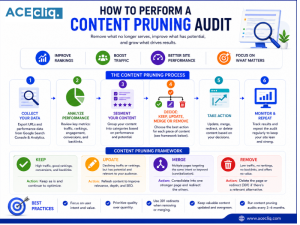
Start by creating a complete inventory of your website's content.
Collect information about each URL, including organic traffic, impressions, rankings, backlinks, conversions, publication date, and topic.
Then classify pages according to their current value.
Pages can generally fall into categories such as:
Keep: Content is useful and performing well.
Update: Content has value but needs improvement.
Merge: Multiple pages overlap and should become one stronger resource.
Remove: Content has little value and no meaningful purpose.
This makes Content Optimization more systematic and less dependent on assumptions.
Analyze Search Intent Before Deleting
Search intent should be one of the most important considerations during content pruning.
A page may have low traffic because it targets a very specific audience rather than because it is poor quality.
Before removing it, search the primary query and examine what Google currently ranks.
If the existing page satisfies a unique intent that your website does not cover elsewhere, improving it may be better than deleting it.
This prevents valuable content from being removed simply because it does not generate large traffic numbers.
Check Backlinks and Internal Links
Before deleting or merging a page, check whether other websites link to it.
A page with valuable backlinks may have authority that should be preserved through an appropriate consolidation or redirect strategy.
Also review internal links pointing toward the page.
If you remove a URL, update relevant internal links so users are not sent to unnecessary redirects or broken destinations.
A clean internal linking structure supports better navigation and a more organized SEO Content Strategy.
Content Pruning and Organic Traffic
Content pruning can support organic performance when it improves the overall usefulness and focus of a website.
However, it is not a guaranteed method for increasing rankings or traffic.
The purpose should be to improve the quality and organization of your website rather than simply reduce the number of URLs.
A smaller website with strong, relevant resources can be easier to manage and maintain than one filled with outdated and overlapping pages.
How Often Should You Prune Content?
There is no universal schedule for content pruning.
Fast-changing industries may need more frequent reviews, while evergreen websites may require less frequent audits.
A practical approach is to conduct a comprehensive Content Audit periodically and monitor important pages throughout the year.
Focus additional attention on content showing declining traffic, outdated information, ranking losses, or significant changes in search intent.
Avoid Aggressive Content Deletion
One of the biggest mistakes is deleting large numbers of pages without analyzing their value.
Low traffic does not automatically mean low quality.
Some pages may target highly specific searches, support important conversion journeys, or have valuable backlinks.
Content pruning should therefore be evidence-based.
Analyze the page first, determine its purpose, and then decide whether updating, merging, redirecting, or removing it is the most appropriate action.
Final Conclusion
SEO Content Pruning is about making your website more useful, relevant, and strategically organized. The objective is not to remove content simply because it is old or receives limited traffic.
Instead, businesses should evaluate each page based on content quality, search intent, organic performance, backlinks, conversions, and its role within the website.
Update valuable pages that have become outdated, merge overlapping resources when they serve the same intent, and remove content only when it genuinely provides no ongoing value.
At ACECLiQ, we help businesses conduct content audits, identify content decay, resolve overlapping pages, improve existing resources, and build focused SEO Content Strategies that support stronger organic visibility and sustainable search growth.