
Link Building vs Digital PR: Which Strategy Is Better for SEO Authority?
Building a strong website is only one part of SEO. Even with excellent technical SEO and valuable content, businesses may need to establish credibility beyond their own website to compete effectively in search results.
This is where Link Building vs Digital PR becomes an important discussion.
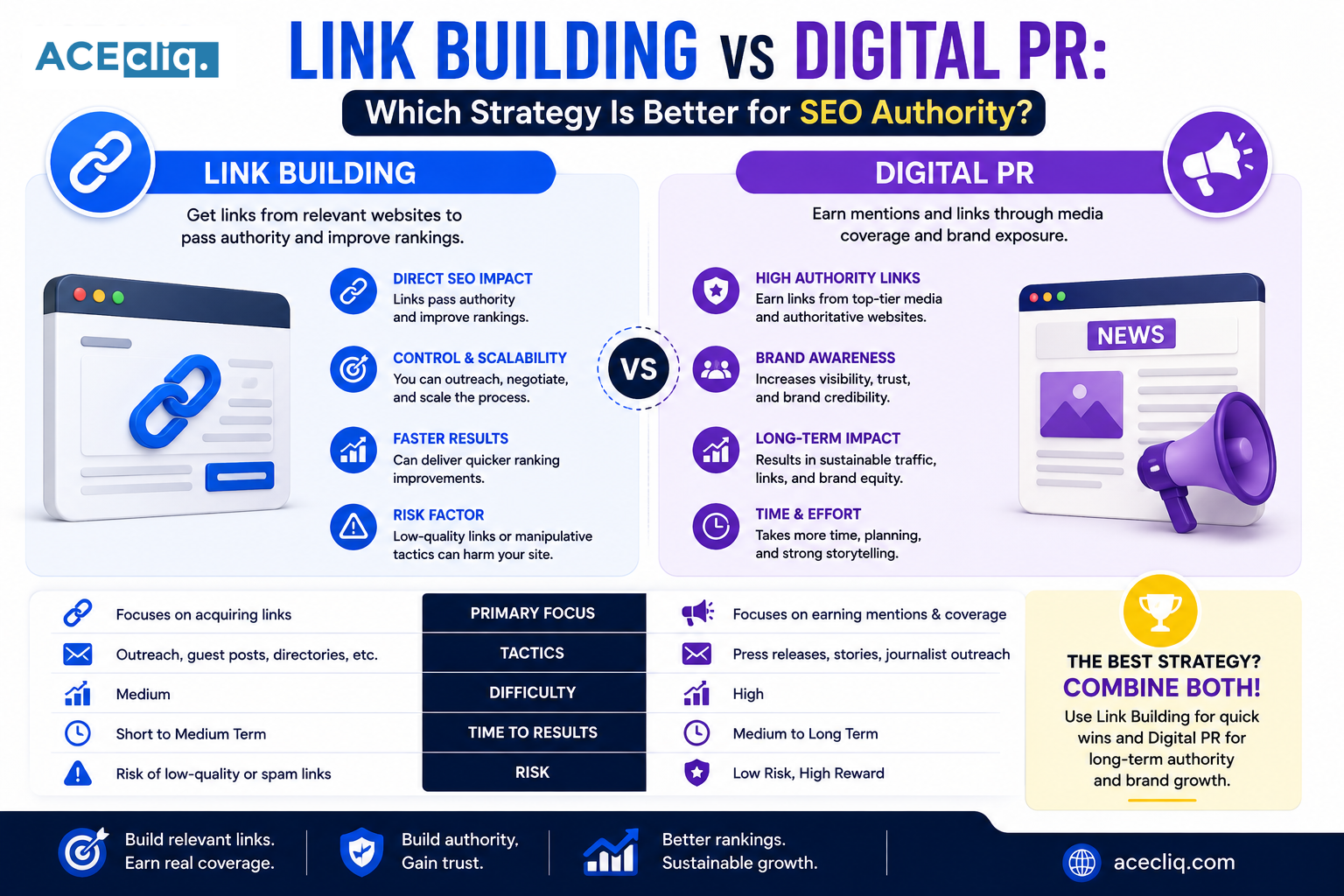
Both strategies can help businesses earn visibility, references, and valuable connections from other websites. However, their methods and broader objectives are different.
Traditional link building generally focuses on acquiring relevant backlinks, while digital PR focuses on creating newsworthy stories, campaigns, research, and ideas that can earn coverage from publishers and media outlets.
The best strategy depends on your goals, industry, resources, and the type of authority you want to build.
AI Overview
Link building and digital PR are both off-page strategies that can support SEO authority, but they work differently. Link building typically focuses on acquiring relevant, authoritative backlinks to strengthen a website's visibility and authority. Digital PR focuses more broadly on earning media coverage, brand mentions, links, and public visibility through newsworthy stories and campaigns. For many businesses, the strongest approach is not choosing one exclusively but combining high-quality link acquisition with digital PR to build relevant authority, brand recognition, and sustainable organic visibility.
What Is Link Building?
Link building is the process of earning or acquiring backlinks from other websites to your own website.
A backlink can act as a discovery path for users and can also provide a signal about the relationship and relevance between websites.
However, not all backlinks are equally valuable.
A relevant editorial link from a reputable website can be far more meaningful than a large number of irrelevant or low-quality links.
Modern SEO should therefore focus on quality, relevance, and editorial value rather than simply increasing backlink counts.
What Is Digital PR?
Digital PR combines public relations principles with online marketing to generate attention, coverage, brand mentions, and potentially backlinks.
A Guest Post campaign might involve original research, industry data, expert commentary, surveys, reports, newsworthy campaigns, or unique stories.
The objective is to give journalists, publishers, bloggers, and industry websites a reason to talk about the brand.
Unlike traditional outreach that may ask websites directly for links, digital PR often focuses on creating something genuinely interesting enough to earn coverage.
Link Building vs Digital PR: The Main Difference
The simplest distinction is the primary objective.
Link building is generally more directly focused on earning relevant backlinks.
Digital PR has a broader focus on brand awareness, media coverage, reputation, mentions, referral traffic, and links.
For example, an SEO campaign might identify authoritative industry websites and develop useful outreach opportunities.
A digital PR campaign might publish original research about an industry trend and pitch the findings to journalists.
Both can contribute to SEO, but they operate differently.
How Link Building Supports SEO
Backlinks remain an important part of how search engines evaluate relationships between websites.
Relevant links from authoritative sources can help search engines discover content and understand that other websites reference or endorse a resource.
Link building can be particularly useful for competitive industries where high-quality content alone may not be enough to compete.
However, businesses should avoid low-quality tactics such as buying manipulative links, creating irrelevant link networks, or pursuing links solely because a website has a high metric score.
A sustainable Backlink Strategy should prioritize relevance and genuine editorial value.

How Digital PR Supports SEO
Digital PR can support SEO while simultaneously building broader brand visibility.
A successful campaign may result in coverage across industry publications, news websites, specialist blogs, and other authoritative sources.
This can create valuable backlinks as well as referral traffic and increased brand awareness.
Digital PR can also help businesses become associated with specific topics or areas of expertise.
For example, a technology company publishing original research on AI adoption may gain coverage from technology publications while strengthening its broader reputation within the industry.
Which Strategy Builds Better SEO Authority?
There is no universal winner.
If your primary objective is acquiring relevant backlinks to specific pages, traditional SEO Link Building may be the more direct approach.
If your goal includes backlinks alongside brand awareness, media exposure, thought leadership, and industry recognition, digital PR may offer broader benefits.
For established brands, digital PR can create large-scale visibility.
For smaller businesses, targeted link building can sometimes provide a more focused and practical approach.
The strongest strategy is often a combination of both.
When Should Businesses Use Link Building?
Link building can be useful when your website already has valuable content but needs stronger external authority.
Start by identifying pages that deserve references.
These might include detailed guides, research, useful tools, original resources, case studies, or important service pages.
Then identify relevant websites that would genuinely benefit their readers by linking to the resource.
Personalized outreach is generally more effective than sending identical messages to hundreds of websites.
When Should Businesses Use Digital PR?
Digital PR is particularly useful when a business has something newsworthy to communicate.
Original research is one of the strongest examples.
A company could conduct a survey, analyze industry data, publish a report, or identify an interesting trend.
The resulting insights can then be presented as a story rather than simply promoted as a company asset.
This gives publishers a stronger reason to cover the subject.
Digital PR can also be effective for businesses that want to increase Brand Authority beyond search rankings.
How to Combine Both Strategies
Businesses do not need to treat link building and digital PR as competing strategies.
They can work together.
For example, a business could create an original industry report through a digital PR campaign and then use targeted outreach to connect relevant supporting resources with industry websites.
Similarly, a strong piece of linkable content can become the foundation for a PR campaign.
This creates a broader Off-Page SEO Strategy where content, outreach, media relations, backlinks, and brand visibility reinforce one another.

Create Content Worth Linking To
Neither strategy works well without something valuable to promote.
Businesses should invest in assets that provide genuine usefulness.
These can include:
- Original research
- Industry reports
- Data studies
- Expert guides
- Case studies
- Free tools
- Calculators
- Original statistics
- Comprehensive resources
The stronger the resource, the easier it becomes to explain why another website should reference it.
Avoid Focusing Only on Backlink Numbers
A common SEO mistake is judging success by the number of links acquired.
Ten highly relevant editorial backlinks can potentially be more valuable than hundreds of unrelated links.
Look at the context of the link, the relevance of the website, the quality of the surrounding content, and whether the link can introduce your business to a valuable audience.
The objective should be building a trustworthy web presence, not simply increasing a backlink counter.
How to Measure Results
Measure both SEO and broader marketing outcomes.
For link building, monitor relevant referring domains, backlinks, ranking changes, organic visibility, and referral traffic.
For digital PR, also consider media coverage, brand mentions, referral traffic, audience reach, and branded search interest.
Most importantly, connect these activities to business outcomes wherever possible.
A campaign that generates impressive media coverage but no relevant audience may need refinement.
Similarly, a campaign that earns links but has no meaningful relationship to your target market may not deliver the expected business value.
Common Mistakes to Avoid
One of the biggest mistakes is treating digital PR as mass email outreach.
Another is pursuing backlinks from unrelated websites simply because they appear authoritative.
Businesses should also avoid creating news stories that have no genuine news value or producing content solely to attract links.
Quality should come before quantity.
The most sustainable Authority Building strategies create useful resources, establish genuine relationships, and earn recognition from relevant audiences.
Final Conclusion
The debate around Link Building vs Digital PR does not need to have a single winner.
Link building provides a focused approach to earning relevant backlinks, while digital PR can combine links with media exposure, brand awareness, thought leadership, and broader authority.
For businesses that want sustainable SEO growth, the strongest approach is often to use both strategically.
Create genuinely valuable resources, build relationships with relevant websites, develop newsworthy stories, and focus on earning recognition rather than manipulating search signals.
At ACECLiQ, we help businesses develop sustainable off-page SEO strategies that combine quality link building, digital PR, content promotion, and authority building to strengthen organic visibility and support long-term search growth.