
Programmatic SEO: How Businesses Can Scale Organic Traffic Without Creating Thousands of Weak Pages
Creating hundreds or thousands of SEO pages does not automatically generate organic traffic. If those pages contain repetitive information, provide little value, or exist only to target slightly different keywords, they can create a poor experience for users and a difficult website to manage.
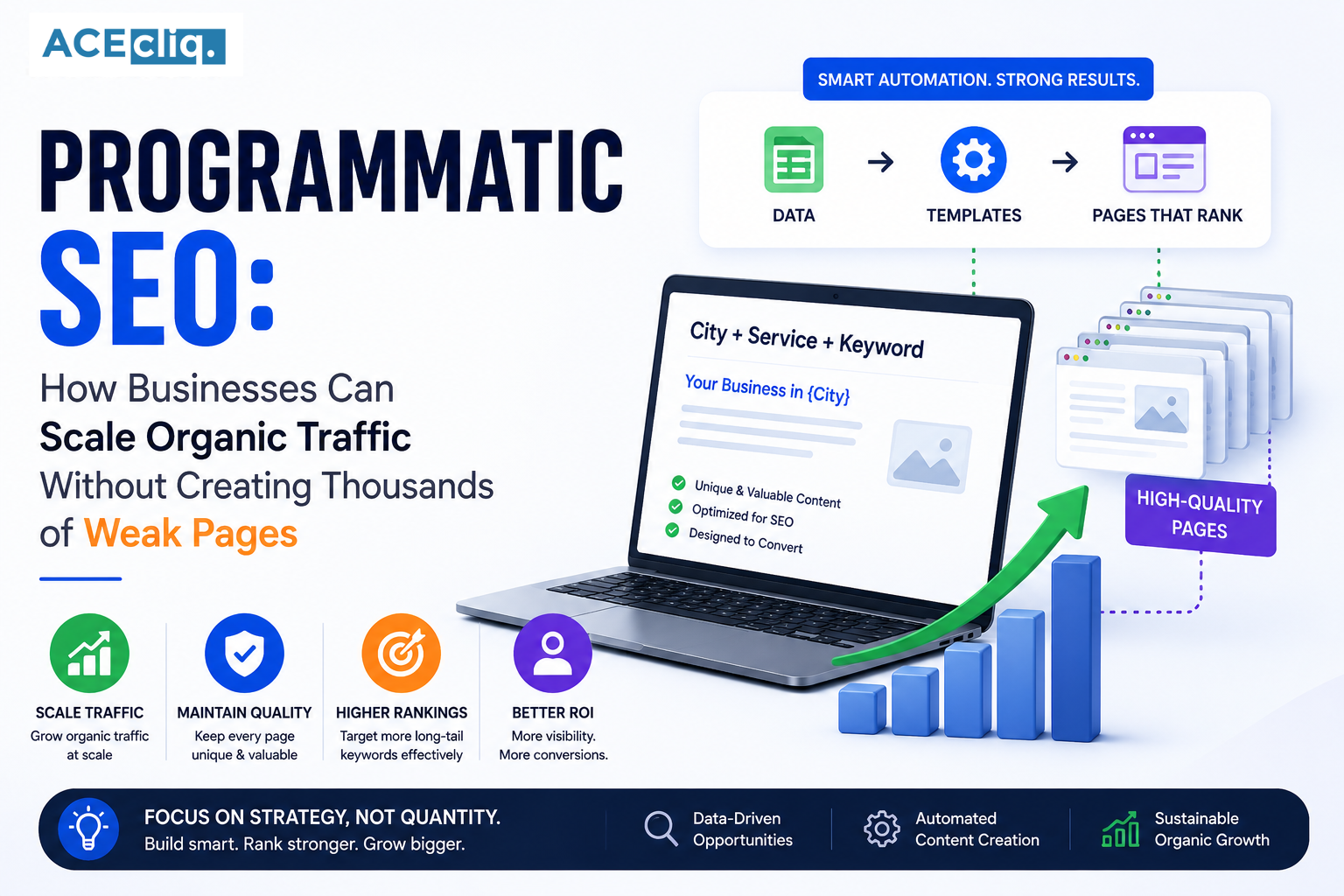
Programmatic SEO takes a different approach. It uses structured data, templates, automation, and scalable website architecture to create pages around a large number of relevant searches.
The important part is quality at scale.
A successful programmatic SEO strategy creates pages because users genuinely need them, not simply because a business wants more URLs indexed by Google.
At ACECLiQ, we focus on scalable SEO strategies that combine search intent, useful data, content quality, technical SEO, internal linking, and user experience.
AI Overview
Programmatic SEO is an approach to creating large numbers of targeted webpages using structured data, templates, and automation while maintaining useful content and a strong user experience. It works best when each page serves a distinct search intent and provides genuine value rather than simply replacing keywords in the same template. Businesses can use programmatic SEO for areas such as locations, products, services, comparisons, directories, and other structured search opportunities. Quality control, unique information, technical SEO, and index management are essential to prevent thin or repetitive pages.
What Is Programmatic SEO?
Programmatic SEO is a method of creating many targeted pages from a structured dataset and a reusable page framework.
For example, a travel website could create pages for different destinations, hotels, routes, or activities. An ecommerce website could generate pages for meaningful product combinations. A business directory could create pages for different services and locations.
The technology makes creating these pages scalable, but the SEO value comes from whether each page provides something useful and distinct.
How Programmatic SEO Works
A typical programmatic SEO system combines three major components: data, templates, and page generation.
The data provides information that changes from page to page. The template controls the structure and user experience. The generation system combines these elements into individual URLs.
For example, a website targeting local searches might use structured information about cities and services to create pages such as service-plus-location combinations.
However, simply generating a page for every possible combination is not a strategy.
Each URL should have a clear purpose and satisfy a meaningful search intent.
When Businesses Should Use Programmatic SEO
Programmatic SEO works best when a business has a large set of related search opportunities with consistent structures.
Common examples include location pages, product databases, property listings, service directories, comparison pages, job listings, travel destinations, and other structured information.
The opportunity becomes particularly strong when users search for specific combinations of attributes.
Before implementation, businesses should determine whether those searches actually represent meaningful demand and whether they can provide enough useful information on each page.
Finding the Right Programmatic SEO Opportunity
Start with keyword and audience research.
Look for search patterns where users combine a core topic with different variables.
For example:
[service] + [location]
[product] + [attribute]
[software] + [use case]
The variables should represent genuine differences in user needs.
Avoid generating pages simply because a keyword tool produces hundreds of variations.
Search demand, relevance, competition, available data, and business value should all be considered.
Build a Scalable Page Template
A good template creates consistency without making every page identical.
The page should have a clear title, useful introduction, relevant information, supporting details, internal links, and an appropriate call to action.
Dynamic elements can change based on the page's subject.
For example, a location page should contain genuinely useful information about that location rather than simply replacing the city name throughout an identical article.
The template should support SEO at Scale while preserving page usefulness.
Use Unique and Useful Data
Data is often what makes programmatic pages valuable.
Instead of creating pages that contain only automatically generated text, incorporate information that is genuinely different for each URL.
This could include product specifications, pricing information, location details, availability, statistics, comparisons, reviews, or other relevant datasets.
The more useful the underlying data, the more valuable the resulting page can become.
Avoid Thin and Duplicate Content
The biggest risk of programmatic SEO is creating thousands of low-value pages.
If every page contains almost identical content with only a few words changed, users have little reason to visit each URL.
This can create Thin Content and unnecessary duplication.
Before launching a large page set, review sample pages manually.
Ask whether each page provides enough unique information to justify its existence.
If the answer is no, reduce the number of pages or improve the underlying data.
Optimize Programmatic Pages for SEO
Each generated page should still follow fundamental SEO principles.
Use descriptive titles, relevant H1 headings, logical H2 sections, clean URLs, useful metadata, optimized images where appropriate, and relevant internal links.
Content should naturally reflect the page's topic and search intent.
Avoid automatically inserting keywords into every possible location.
Good Programmatic SEO Strategy combines automation with editorial and technical quality control.
Create Strong Internal Linking

Large programmatic websites can quickly become difficult to navigate.
Internal linking helps users and search engines discover related pages.
For example, location pages can link to nearby locations, while product pages can connect to relevant categories and related products.
Create logical relationships rather than randomly linking hundreds of URLs.
A clear architecture helps users understand how pages are connected.
Manage Indexing and Technical SEO
Not every generated URL needs to be indexed.
Filters, combinations with no meaningful search demand, duplicate variations, and incomplete pages may create unnecessary URLs.
Use appropriate technical controls and carefully decide which pages should be available for search engines.
Monitor crawl activity, indexing, canonicalization, redirects, and sitemap coverage as the website expands.
Technical SEO management becomes increasingly important as the number of URLs grows.
Measure Programmatic SEO Performance
Do not judge a programmatic SEO project solely by the number of pages published.
Measure impressions, clicks, rankings, organic traffic, engagement, conversions, and revenue where applicable.
Look at performance at the page-template level as well.
If one page type performs well while another generates no meaningful visibility, investigate why.
Data should guide which templates are expanded, improved, or removed.
Common Programmatic SEO Mistakes
The most common mistake is prioritizing quantity over usefulness.
Other problems include generating pages without sufficient search demand, using the same content across thousands of URLs, ignoring user experience, indexing every possible URL, and failing to maintain the underlying data.
Automation should make content production more efficient—not eliminate quality control.
Human review remains important, particularly when pages influence important business decisions or contain information that needs to be accurate.
Final Conclusion
Programmatic SEO can help businesses capture large numbers of relevant search opportunities, but scale alone does not create SEO value.
The strongest implementations combine meaningful search demand, useful data, distinct search intent, strong page templates, technical SEO, internal linking, and continuous quality control.
The goal should never be to create thousands of pages simply because technology makes it possible. The goal is to create thousands of useful pages only when users genuinely benefit from having them.
At ACECLiQ, we help businesses identify scalable SEO opportunities and build programmatic strategies that balance automation with content quality, technical performance, search intent, and long-term organic growth.