
AEO vs GEO vs SEO: Understanding the Future of Search in 2026 | ACECLiQ
Search has undergone a dramatic transformation over the past few years. Users are no longer relying solely on traditional search engines to find information. AI-powered platforms, conversational assistants, and generative search experiences are changing how people discover businesses, products, and services online.
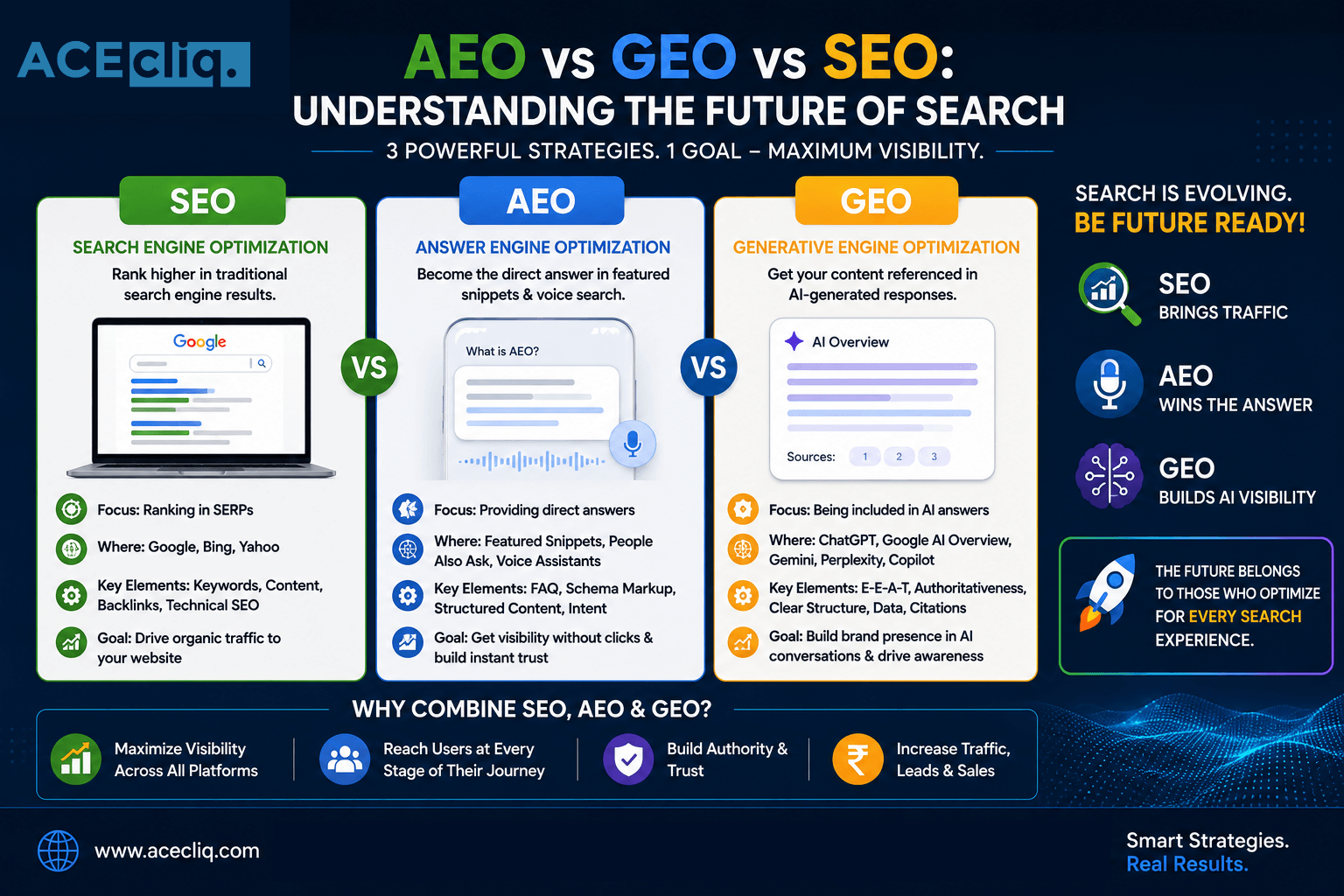
Understanding AEO vs GEO vs SEO: Understanding the Future of Search has become essential for businesses that want to remain visible in this evolving digital landscape. While traditional SEO continues to drive organic traffic, Answer Engine Optimization (AEO) and Generative Engine Optimization (GEO) are creating new opportunities to appear in AI-generated responses, voice assistants, and intelligent search experiences.
Businesses that combine all three strategies will be better positioned to attract qualified visitors, build authority, and maintain long-term online visibility.
At ACECLiQ, we help businesses prepare for the future by integrating SEO, AEO, and GEO strategies into a comprehensive digital marketing approach.
AI Overview
The search landscape is evolving rapidly as artificial intelligence changes how users discover information online. Traditional SEO remains essential for improving organic rankings on search engines, while Answer Engine Optimization (AEO) focuses on helping websites appear as direct answers in featured snippets and voice search. At the same time, Generative Engine Optimization (GEO) is emerging as a new strategy that helps AI platforms like ChatGPT, Google AI Overviews, Gemini, and other generative search engines reference trustworthy content. Understanding AEO vs GEO vs SEO: Understanding the Future of Search allows businesses to build a future-ready content strategy that improves visibility across both traditional search engines and AI-powered search experiences.
The Evolution of Search
Search engines have evolved from simple keyword-matching systems into intelligent platforms capable of understanding context, user intent, and conversational queries.
Previously, users typed short phrases such as "SEO company Delhi."
Today, they ask detailed questions like:
"Which SEO agency is best for ecommerce businesses?"
AI-powered search engines now generate complete answers instead of simply listing webpages.
This evolution has introduced new optimization opportunities beyond traditional Search Engine Optimization.
What is SEO?
Search Engine Optimization (SEO) is the practice of improving a website's visibility in traditional search engine results.
SEO focuses on helping webpages rank organically for relevant keywords by improving content quality, technical performance, backlinks, and user experience.
Modern SEO includes:
- Technical optimization
- Keyword research
- Content marketing
- Link building
- Local SEO
- Core Web Vitals
- User experience improvements
SEO remains the foundation of digital visibility because search engines still generate billions of searches every day.
What is AEO?
Answer Engine Optimization (AEO) focuses on helping content become the direct answer to user questions.
Instead of ranking only as a webpage, optimized content appears in:
- Featured snippets
- Voice search
- FAQ results
- People Also Ask sections
- AI-generated summaries
A successful AEO strategy emphasizes structured content, concise answers, schema markup, and clear question-based formatting.
Businesses implementing Answer Engine Optimization improve their chances of becoming Google's preferred answer for informational queries.
What is GEO?
Generative Engine Optimization (GEO) is a newer optimization strategy designed for AI-powered search experiences.
Unlike traditional search engines that display lists of websites, generative AI platforms create personalized responses by combining information from trusted sources.
Generative Engine Optimization helps businesses create authoritative content that AI systems are more likely to reference when generating responses.
Examples include:
- ChatGPT
- Google AI Overviews
- Gemini
- Copilot
- Perplexity AI
As AI search adoption grows, GEO is becoming an increasingly important part of digital marketing.
AEO vs GEO vs SEO: What's the Difference?
Although all three strategies aim to improve online visibility, they focus on different search experiences.
SEO helps webpages rank in traditional organic search results.
AEO helps businesses become direct answers for search queries and voice assistants.
GEO helps AI platforms reference your content when generating intelligent responses.
Rather than competing with each other, these approaches complement one another.
Businesses that combine all three create stronger search visibility across multiple platforms.
Why AI is Transforming Search
Artificial Intelligence has fundamentally changed how search engines interpret information.
Modern AI algorithms understand:
- Context
- User intent
- Semantic relationships
- Content quality
- Authority
- Trustworthiness
This means businesses can no longer rely solely on keyword density.
Instead, success depends on creating valuable, expert-level content that genuinely answers user questions.
AI is rewarding websites that prioritize experience, expertise, and helpful information.
Why Businesses Should Combine SEO, AEO, and GEO
Many organizations mistakenly believe they must choose between these strategies.
In reality, the strongest digital marketing approach combines all three.
Traditional SEO generates sustainable organic traffic.
AEO increases visibility within featured answers and conversational search.
GEO positions businesses to appear within AI-generated responses.
Together, they create a comprehensive search strategy capable of reaching users regardless of how they search.
How to Optimize for SEO, AEO, and GEO
A future-ready content strategy begins with understanding user intent rather than focusing only on keywords.
Businesses should create comprehensive resources that answer common questions, demonstrate expertise, and provide practical value.
Content should include:
- Clear headings
- FAQ sections
- Structured data
- Original insights
- Real-world examples
- Internal linking
- Reliable sources
These elements improve both traditional search visibility and AI comprehension.
Common Mistakes Businesses Make
Many websites continue relying on outdated SEO techniques.
Some common mistakes include:
- Publishing thin content
- Ignoring structured data
- Overusing keywords
- Neglecting user intent
- Creating isolated articles instead of topic clusters
- Failing to demonstrate expertise
Avoiding these issues helps businesses build stronger authority across both traditional and AI-powered search.
The Future of Search in 2026
Search is becoming increasingly conversational, personalized, and AI-driven.
Businesses that focus only on conventional SEO risk losing visibility as users adopt new search experiences.
Future success will depend on producing trustworthy, well-structured, and genuinely helpful content that performs across multiple search environments.
Organizations that invest in SEO, AEO, and GEO today will be better prepared for tomorrow's search ecosystem.
Final Conclusion
Understanding AEO vs GEO vs SEO: Understanding the Future of Search is no longer optional for businesses that want to remain competitive online.
Traditional SEO continues to be the foundation of organic visibility, while Answer Engine Optimization improves the likelihood of appearing in featured answers and voice search. At the same time, Generative Engine Optimization is opening new opportunities to become a trusted source for AI-powered search platforms.
Rather than viewing these strategies as competitors, businesses should combine them to build a future-proof digital presence. At ACECLiQ, we help businesses implement integrated SEO, AEO, and GEO strategies that improve search visibility, increase authority, and prepare brands for the next generation of AI-powered search.