How to Build a High-Performance AI-Ready Marketing Funnel in 2026
AI Overview:
A high-performance AI-ready marketing funnel in 2026 is a dynamic, intent-driven system that uses artificial intelligence, behavioral data, and automation to guide users from discovery to loyalty. It matters because consumers now interact across AI search, social platforms, and mobile devices simultaneously. Businesses must design funnels that adapt in real time, personalize experiences, and align with EEAT standards to improve visibility, conversions, and long-term customer value in generative and AI-powered search environments.

Table Of Content
Introduction
Marketing funnels in 2026 are no longer linear or channel-specific. Consumers move fluidly between search engines, AI assistants, social media, and brand platforms, often making decisions before direct contact. At the same time, Google’s EEAT framework and generative search models reward experience-backed, intent-focused content over aggressive promotion. This shift makes traditional funnels ineffective. Building an AI-ready marketing funnel is now essential for businesses that want predictable growth, higher-quality leads, and sustainable authority. A modern funnel combines AI intelligence, personalization, and data-driven optimization to match how users actually discover, evaluate, and trust brands today.
The Strategic Role of AI in Modern Marketing Funnels
An AI-ready marketing funnel is designed to respond, not just operate. Instead of pushing users through fixed stages, it continuously learns from behavior, intent signals, and engagement patterns. AI connects SEO, content, paid media, and automation into a unified system that adapts messaging, timing, and channels automatically. The result is a funnel that prioritizes relevance, reduces friction, and supports decision-making at every touchpoint.
How an AI-Ready Funnel Actually Works in 2026
Intent-Based Discovery Across AI & Search
Users enter funnels through AI-powered search results, featured snippets, voice queries, social feeds, and short-form videos. Visibility depends on usefulness, context, and authority—not keyword density.
Experience-Led Engagement Instead of Lead Chasing
Educational content, interactive tools, and expert insights nurture users naturally while building trust signals for both users and search engines.
Predictive Conversion Optimization
AI identifies high-intent moments and dynamically triggers CTAs, offers, or demos based on readiness rather than assumptions.
Lifecycle Expansion & Retention
Automation supports onboarding, education, re-engagement, and advocacy, increasing lifetime value beyond the first conversion.
Core Pillars of a High-Performance AI Funnel
AI-Driven Behavioral Intelligence
Machine learning analyzes clicks, scroll depth, engagement time, and interactions to refine funnel decisions continuously.
Personalization at Scale
Content, ads, and emails dynamically adapt to user context, device, location, and intent stage.
Mobile-First & Speed-Centric Design
Fast-loading, distraction-free mobile experiences directly impact rankings, trust, and conversion rates.
Social Proof & Community Influence
Reviews, creators, and expert validation strengthen credibility and reduce decision friction.
Real-Time Data Feedback Loops
Dashboards replace assumptions with actionable insights, enabling faster optimization.
AI Funnel Trends Defining 2025–2026
- AI Overview and zero-click optimization
- Conversational and voice-based funnel entry
- First-party data–led personalization
- Predictive lead scoring and automation
- Omnichannel attribution modeling
- Privacy-first marketing infrastructure
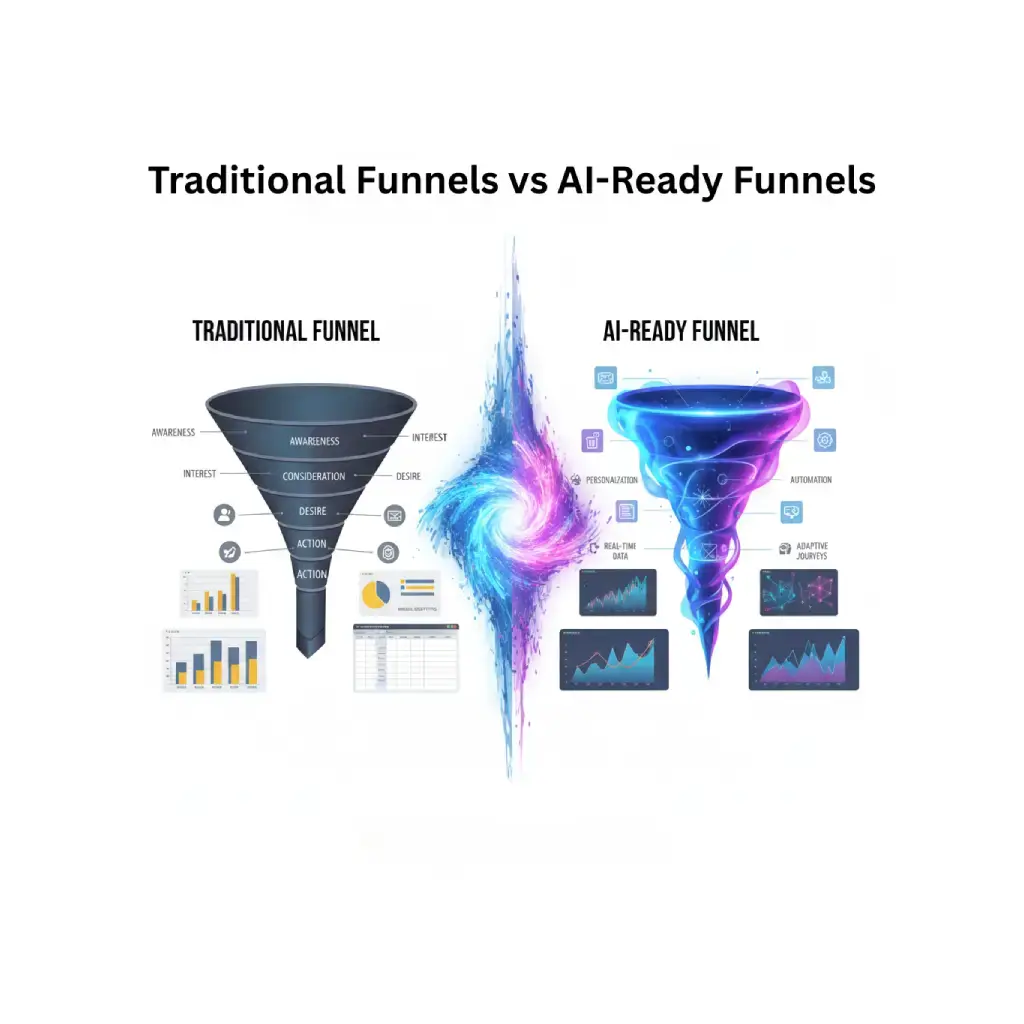
Traditional Funnels vs AI-Ready Funnels
|
Traditional Funnel |
AI-Ready Funnel (2026) |
|
Linear stages |
Adaptive, non-linear journeys |
|
Manual targeting |
Predictive personalization |
|
Channel silos |
Unified omnichannel flow |
|
Static messaging |
Context-aware content |
|
Conversion-only focus |
Lifetime value optimization |
How Consumer Expectations Are Reshaping Funnels
Modern consumers expect instant relevance, expert guidance, and consistent experiences across platforms. They trust brands that educate, not interrupt. AI-ready funnels align with these expectations by anticipating needs, reducing friction, and delivering value before conversion. Businesses using intelligent funnels report higher engagement quality, stronger authority signals, and improved long-term growth.
Conclusion
A high-performance AI-ready marketing funnel in 2026 is built on intelligence, trust, and experience—not volume or shortcuts. Businesses that adopt adaptive, data-driven funnels gain sustainable growth and long-term authority.
If you’re ready to build a future-proof marketing funnel, now is the time to act.
FAQs
What defines a high-performance marketing funnel in 2026?
A funnel that uses AI, intent data, and personalization to adapt user journeys in real time.
Is AI funnel building only for large businesses?
No. Scalable tools make AI-driven funnels accessible to small and mid-sized businesses.
How does AI improve funnel conversion rates?
By predicting intent, optimizing timing, and delivering context-relevant experiences.
Does SEO still matter in AI-driven funnels?
Yes. SEO now focuses on usefulness, expertise, and AI search visibility.
Recent Comments